Custom Steel Book Trolleys: The Guide to Wholesale Sourcing and Structural Design
In modern libraries, archives, schools, and corporate offices, the humble book trolley is more than just a moving shelf—it is the backbone of logistics. It dictates the efficiency of re-shelving workflows and influences the physical well-being of the staff who push them miles every day.
While book trucks come in wood or plastic, Steel Book Trolleys remain the undisputed king of commercial environments. Their unmatched durability, load-bearing capacity, and structural stability make them the primary choice for long-term investment.
As a dedicated manufacturer (Hengna Office), we have compiled this guide to help wholesalers and project managers navigate the technical details of sourcing high-quality custom steel trolleys.
Part 1: Why Steel? The Case for Durability
Before diving into design specs, it is crucial to understand why steel is the superior material for your inventory. Compared to wood (which chips) or plastic (which can crack under load), steel offers specific advantages for institutional use:
- Impact Resistance: Steel withstands the daily bumps against doorframes and desks without compromising structural integrity.
- High Load Capacity: Essential for transporting dense materials like encyclopedias, archives, or heavy equipment.
- Stability: A welded or bolt-connected steel frame prevents the “wobble” often seen in cheaper alternatives.
- Sanitation & Maintenance: Smooth, powder-coated surfaces are easy to wipe down, rust-resistant, and ideal for high-traffic public spaces.
- Professional Aesthetics: Clean lines and industrial strength fit seamlessly into both modern university libraries and corporate mailrooms.
Part 2: Key Considerations for Wholesale Sourcing
If you are planning a bulk purchase or looking for an OEM partner, you must look beyond the price tag. Here are the five critical pillars of sourcing:
1. Defining the Use Case
Not all trolleys serve the same purpose. You must match the design to the workflow:
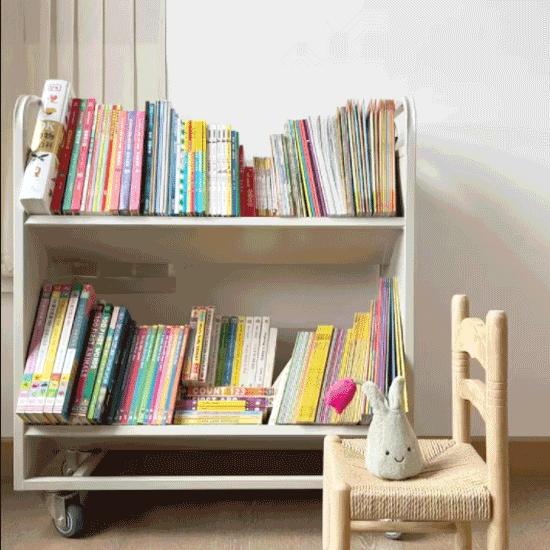
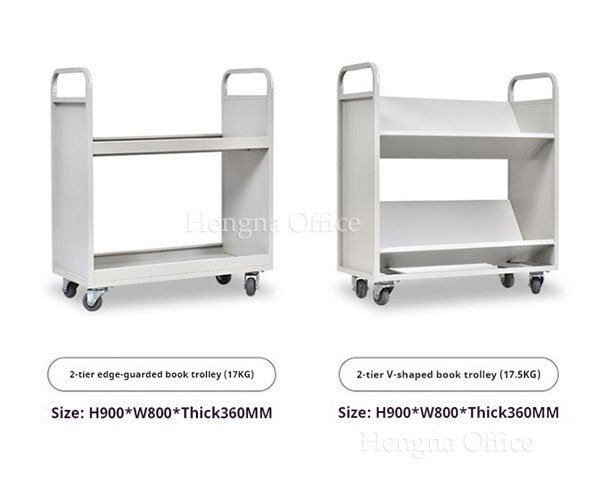
- For Circulation Desks: A 2-tier V-shaped book trolley is ideal. The angled shelves keep books spine-up and prevent them from sliding during rapid transport.
- For Archives & Offices: A 2-tier edge-guarded flat trolley is better suited for stacking boxes, large binders, or mixed media that requires a flat surface.
2. Size and Capacity Planning
Standardization is key for facility management.
- Dimensions: Our standard specification is H900 x W800 x D360mm (Approx. 35.4″ x 31.5″ x 14.2″). This size is carefully calculated to fit through standard doorways, rotate in narrow stack aisles, and fit into service elevators.
- Ergonomics: The height ensures that the average user can push the cart without stooping, and the shelf spacing accommodates standard binders (A4) or large-format books.
3. Material & Craftsmanship
The longevity of the cart depends on the raw material.
- Core Material: We recommend high-grade Cold-Rolled Steel. It offers better surface finish and tensile strength than hot-rolled alternatives.
- Surface Treatment: Look for Electrostatic Powder Coating. This is not just paint; it is a fused protective layer that resists rust and scratching.
- Safety Detailing: Run your hand along the edges. A quality manufacturer ensures all welds are smooth and edges are deburred to prevent injury to staff or damage to books.
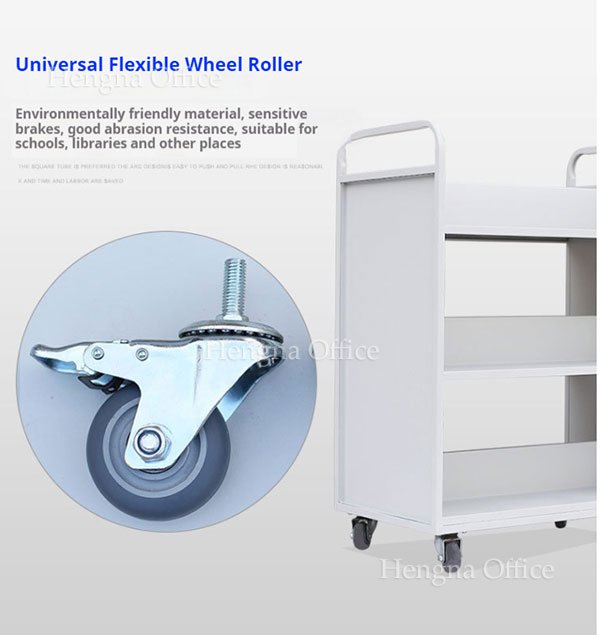
4. The “Engine”: Wheel Selection
A cart is only as good as its wheels. For a library environment, silence is golden.
- Material: We use TPR (Thermoplastic Rubber) or high-grade polyurethane. These are eco-friendly, non-marking, and absorb vibrations on tile or carpet.
- Configuration: A mix of Universal Flexible Wheels (Swivel) and rigid wheels, or 4 swivel wheels with Sensitive Brakes.
- Performance: The brakes must hold the cart steady even on slight inclines (common in ADA-compliant ramps).
5. Evaluating the Supplier
Partner with a manufacturer like Hengna Office that understands the difference between “making a metal box” and “engineering a library tool.”
- Ask for Samples: Always test the “push feel” and cornering ability.
- Check Customization: Can they adjust the color to match a university’s branding?
- Production Capacity: Ensure they can meet your lead times for bulk orders.
Part 3: Deep Dive into Structural Design
To help you choose the right model for your catalog, we have compared the two most popular structural designs below.
| Feature | Flat Edge-Guarded Trolley | V-Shaped Book Trolley |
| Best Application | Archives, Corporate Mailrooms, Oversized Books | Library Returns, Quick Re-shelving |
| Shelf Design | Flat with raised edges to prevent sliding | Angled “V” to use gravity for stability |
| Accessibility | Easy to stack boxes or flat files | easier to read book spines without bending |
| Capacity | High volume (can double stack) | Single row optimized |
| Visual Weight | Solid and substantial | Sleek and accessible |
Essential Design Features for All Models:
- Reinforced Frame: Rectangular or trapezoidal structures with bottom cross-beams to prevent sagging over years of use.
- Safety Corners: Rounded arc corners are mandatory in school settings to prevent injury during collisions.
- Handle Ergonomics: Handles should be integrated into the frame structure for strength, ideally fitted with round tubing or soft-grip covers for user comfort.
Part 4: Customization – Fitting the Product to the Space
Standard “Library Grey” works for many, but modern spaces demand more. Customization is a powerful service for distributors to offer end-clients.
- Size Customization: modifying dimensions to fit under specific counters or through narrow historical archive aisles.
- Color Matching: Using RAL color codes to match the interior design of a new tech office or a children’s library zone.
- Functional Add-ons:
- Magnetic Strips: For inventory tracking.
- Power Cord Management: For carts carrying laptops or scanners.
- Collapsible Designs: For spaces with limited storage.
A steel book trolley might look simple, but its design influences the daily efficiency of an entire organization. Whether you choose the versatile Flat-Shelf model or the specialized V-Shaped model, the details—from the silent casters to the electrostatic finish—matter.
B2B Procurement Tips:
- Test before you buy bulk: Request a sample to verify the welding strength.
- Focus on TCO (Total Cost of Ownership): A slightly cheaper cart that rusts or loses a wheel in 6 months is far more expensive than a quality steel cart that lasts 10 years.
- Collaborate: Work with a supplier who listens to your specific customization needs.
Books are valuable; the vehicle that transports them should be too.
Ready to upgrade your library furniture offerings? Contact Hengna Office today. Let’s discuss how our OEM/ODM steel book trolleys can add value to your product line with professional structural design and manufacturing excellence.