2-Tier Mobile Book Cart for Libraries — How Many Books Fit and What to Check Before Buying
How Many Books Actually Fit on a 2-Tier Cart
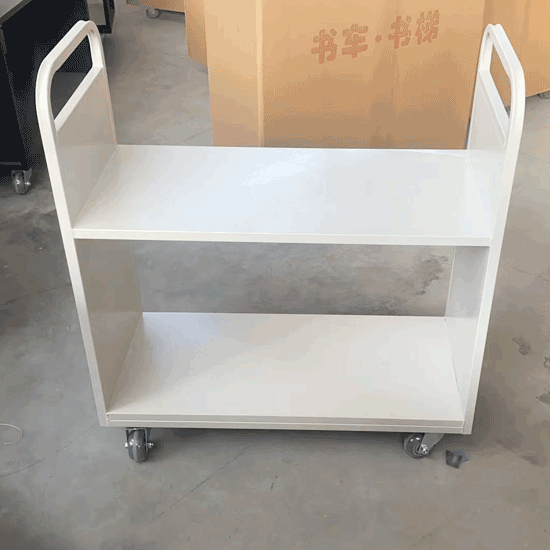
The honest answer: between 80 and 140, depending on the books. A standard 2-tier cart with 900mm-wide shelves holds roughly 40-70 books per tier when books are shelved spine-out and packed normally — not crushed, not stacked two rows deep.
The range exists because books aren’t uniform. Paperback fiction at 25mm spine thickness: about 35 per linear meter of shelf, so 60-70 per tier on a 900mm shelf. Hardcover reference at 45mm spine thickness: closer to 20 per meter, so 40-45 per tier. Picture books and large-format titles drop it further.
For planning purposes, use 120 books per cart as the working number for a mixed library collection. That matches what shelving staff actually move in a typical shift — and it tells you how many carts you need: one cart per 120 books moved per trip, times the number of simultaneous sorting tasks.
The H900mm Height, Explained
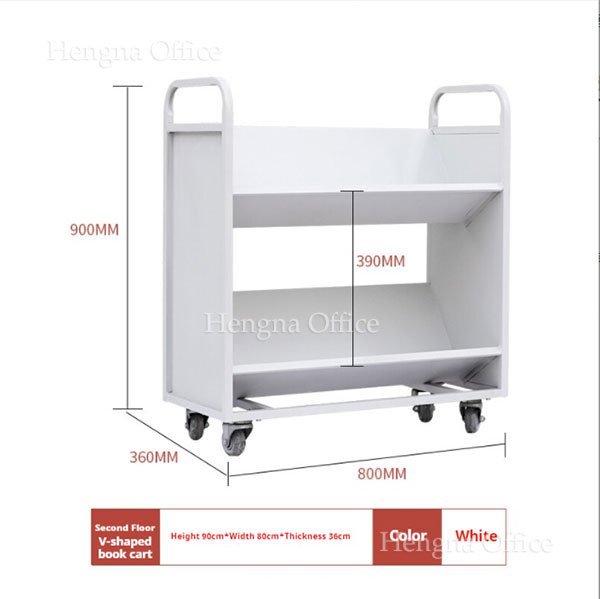
The H900mm specification refers to the height from the floor to the top of the cart’s upper shelf. That number matters more than it looks like. At 900mm, the upper shelf sits slightly below elbow height for the average adult — the natural height for pushing books onto a shelf without lifting them overhead.
Lower carts (700mm) force staff to bend repeatedly; a full shift of bending is what creates back complaints. Higher carts (1000mm+) put the upper shelf at shoulder height, which makes shelving awkward and blocks sight lines when pushing the cart through stacks.
Libraries that serve mixed-height staff benefit from an adjustable-height cart, but for standard fleets, the 900mm working height is the ergonomic sweet spot. It’s also the height that fits under most return counters and sorting desks.

Casters: The Part That Gets Touched Every Hour
Librarians notice casters more than any other component, because they feel every caster flaw 200 times a day. Three specifications separate a good cart from a frustrating one:
- Wheel diameter: 100mm minimum for library carts. Smaller wheels catch on door thresholds, elevator gaps, and carpet seams. 125mm is better for heavy loads.
- Material: Polyurethane tread on a rigid core rolls quietly and doesn’t mark floors. Plain rubber marks vinyl; hard plastic rattles on tile. Ask for polyurethane explicitly.
- Brakes: At least two locking casters per cart. Locking two diagonally opposite wheels holds a loaded cart stable on a slope — and libraries have ramps more often than anyone expects.
Also check swivel vs fixed: two swivel casters at the handle end and two fixed at the other end gives a cart that turns smoothly in stacks and tracks straight in corridors. Four swivel casters make the cart wander.
Book Carts in Libraries vs Bookstores vs Archives
The same 2-tier cart gets used differently in each environment, and that changes what to prioritize:
- Public libraries: Noise matters. Carts roll through reading areas all day. Quiet casters and rubber bumpers on the frame are worth paying for.
- Bookstores: Staff push carts through customer traffic. Maneuverability and a handle that doesn’t snag shopping bags matter most.
- Archives: Documents in archival boxes are heavy and boxy. A cart with a flat top tier (not lipped) makes it easier to slide boxes on and off. Load capacity matters more than aesthetics.
- School libraries: Students push the carts. Look for sturdier handles and locking casters, because a full cart rolling downhill with a 12-year-old at the handle is a real scenario.
Maintenance: What Breaks and What Doesn’t
A steel cart with welded joints and powder coating should last 10+ years in daily library service. The components that wear out are the same three everywhere:
- Caster bearings: Replaceable, and worth replacing at the first sign of roughness. A cart with one bad caster gets pushed harder, which wears the other three.
- Rubber bumpers: The protective strips on frame edges take the hits against door frames. They’re a wear item — budget for replacement every 2-3 years.
- Loose bolts: Some carts assemble with bolts at the cross members. Check and retighten at the same cadence as caster service — twice a year.
Welded-frame carts largely skip the bolt issue but cost more upfront. For a fleet that gets daily use, the welded frame pays for itself in avoided re-tightening within the first year.
How Many Carts Does Your Library Need
Work backwards from traffic. Count the peak-hour returns: a busy branch might process 200 returns per hour, which at 120 books per cart means roughly two carts circulating constantly, plus one for holds sorting, plus one spare for repairs. That’s four carts minimum for a mid-size branch.
A common mistake is buying one cart per sorting station and nothing else. The moment one cart goes for caster repair, the workflow stalls. A spare cart costs a fraction of the workflow disruption it prevents.
Buying Checklist
- Working height confirmed at 900mm, or adjustable to match your staff
- Caster diameter 100mm minimum, polyurethane tread, two locking casters included
- Swivel-fixed caster configuration (not four swivel)
- Shelf lip design verified: low enough for easy sliding, high enough to hold books on a slope
- Load capacity stated in kg per tier, not per cart
- Warranty terms on frame and casters stated separately
- Spare casters and bumpers available for purchase
- Noise level: if possible, test roll on your floor type before ordering a fleet
Need a quote for your library’s cart fleet? Tell us your peak-hour return volume, floor types, and door widths — we’ll spec the right cart and caster combination.
Frequently Asked Questions
What is the weight limit of a loaded 2-tier cart?
A standard steel cart with 900mm shelves carries 80-100 kg per tier in our specification, or 160-200 kg total. That’s far beyond a typical library load of 120 mixed books, which runs 30-45 kg total. The margin matters because carts get loaded unevenly — a stack of heavy reference books at one end of a shelf — and the frame and casters need headroom.
Can a book cart be used outside the library?
Yes, within limits. Carts with polyurethane casters handle sidewalks and ramps, but the casters wear faster on rough concrete. For regular outdoor use — book fairs, outreach events, mobile library programs — specify larger wheels (125mm) and sealed bearings. Indoor carts stay indoors.
Do all library carts need locking casters?
Every cart that stops on a slope needs at least two locks. Library ramps, door thresholds, and elevator gaps are real. The standard configuration is two swivel casters with locks at the handle end. If the cart will be left loaded on a floor with any slope, four locks are worth the small premium.
Can carts be customized with different shelf depths?
Yes. Standard shelf depth is 450mm, sized for spine-out shelving of standard books. Archives storing boxes want 550-600mm depths. Children’s libraries sometimes run shallower shelves so small patrons can reach the back row. Depth changes don’t affect the cart frame — only the shelf panels swap.
How do I clean and maintain a steel book cart?
Wipe the frame with a damp cloth and mild detergent — the powder coating handles standard cleaning chemicals. Lubricate caster bearings twice a year with a light oil. Check the locking mechanisms at the same time. Replace rubber bumpers when they crack, typically every 2-3 years. That’s the whole maintenance schedule.