How to Choose Metal Bookshelves — A Spec-by-Spec Guide for Library Procurement Teams

Start With the Floor, Not the Shelf
A public library in the Midwest ordered 40 bays of shelving in 2023. They planned the layout, counted the books, sized the units. Nobody checked the floor. A fully loaded 900mm-wide, five-tier double-sided bay weighs roughly 700–800 kg concentrated in 0.9 square meters. That’s around 830 kg per square meter — well past the 400 kg/m² live load rating of the upper floor they had chosen.
They caught it during a pre-installation walkthrough. The shelving moved to the ground floor, which was reinforced slab. Cost: a day of replanning and some bruised egos. If they had installed upstairs and the floor cracked six months later, the cost would have been six figures in structural repair plus months of library closure.
Before you look at a single shelf specification, confirm your floor load rating. Most commercial buildings rate upper floors for 250–400 kg/m² live load. Dense shelving can double or triple that. A structural engineer can verify in an afternoon. It is the cheapest insurance you will buy on the entire project.
How to Choose Metal Bookshelves-Steel Gauge — The One Number That Predicts Shelf Lifespan
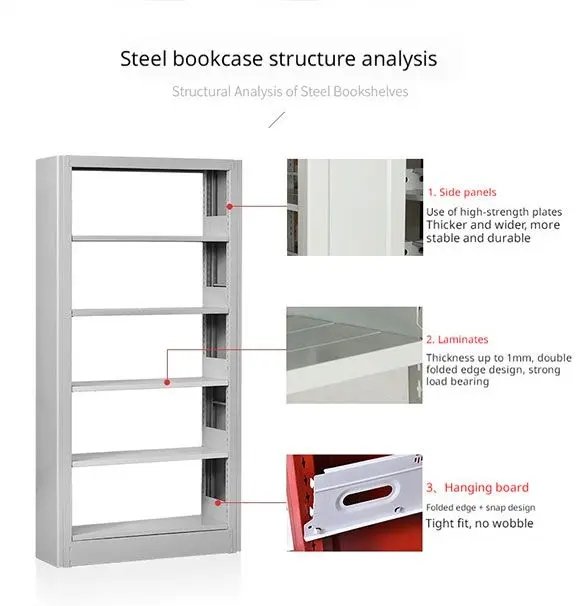
Steel thickness in shelving uses gauge measurement. Lower gauge means thicker steel. Here is a practical field guide based on what we have seen in libraries over 15+ years:
- 22-gauge (0.8mm): Shelf panels only, and only in low-traffic back-office storage accessed once a week. Load rating: roughly 30–40 kg before visible sag develops within 2 years. Do not use for any shelf the public can reach.
- 20-gauge (1.0mm): The absolute minimum for library shelving. Visible deflection at 50–60 kg per shelf after 2–3 years. Acceptable for paperback fiction sections. Borderline for reference collections with heavier books.
- 18-gauge (1.2mm): This is what institutional libraries should specify for uprights and heavily-used shelves. Holds 80 kg without measurable deformation over a decade. Costs 15–20% more than 20-gauge. Over a 15-year service life, that premium works out to roughly 1% per year.
- 16-gauge (1.5mm): Used in archival shelving where boxes of documents create very high point loads on small contact areas. Adds substantial weight and cost. Over-specifying to 16-gauge where 18-gauge would suffice wastes budget.
Upright gauge matters more than shelf gauge. Thin uprights twist under uneven loading, and a twisted upright makes every shelf above it tilt — patrons notice, books slide, complaints follow.
Adjustable Shelves Save More Money Than They Cost
Fixed shelves are cheaper per unit. They are more expensive per usable book. Library collections are not uniform — art books run 350mm tall, paperback fiction 180mm, reference atlases 450mm. Fixed shelves spaced at 300mm waste the space above paperbacks and cannot accommodate oversize volumes.
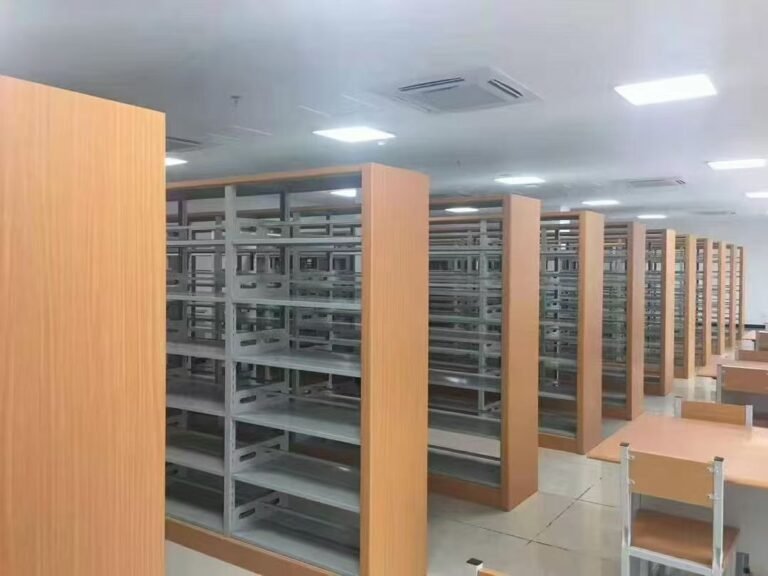
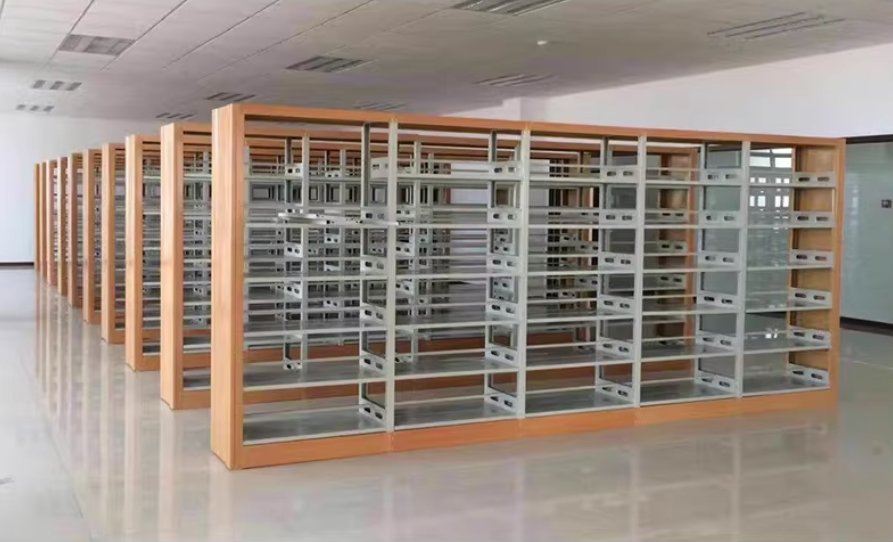
Adjustable shelves on punched vertical rails let spacing change in 25mm increments. A staff member reconfigures a bay in under 10 minutes when the collection mix changes. The rail system adds roughly 8–12% to unit cost. For a library that reorganizes sections every 2–3 years, that premium pays for itself in recovered shelf capacity within the first reorganization.
Powder Coating: Three Questions That Separate Quality From Marketing
All metal shelves are “painted.” Wet spray paint at room temperature looks fine for about 3 years, then begins to chip at edges and corners where books slide in and out. Electrostatic powder coating — dry powder sprayed onto electrically charged steel, baked at 180–200°C — bonds into a single polymer layer fused to the metal. Three questions tell you whether a manufacturer is using quality finishing:
- Curing temperature: Should be 180–200°C for epoxy-polyester powder. Below 170°C, the powder does not fully cross-link, and the coating will fail at edges within 5 years.
- Coating thickness: 60–90 microns for library shelving. Below 50 microns, coverage is too thin at corners and edges where wear concentrates.
- Pre-treatment: Phosphating or zinc phosphate wash before coating. Without it, microscopic rust starts at any scratch within months. With it, a scratch exposes protected steel that resists oxidation.
A manufacturer who hesitates on any of these three questions is using a lower-cost finishing line. The shelves will look identical on day one. The difference becomes visible in year four.
Welded vs. Bolt-Together: Choose Based on Your Building, Not Your Budget
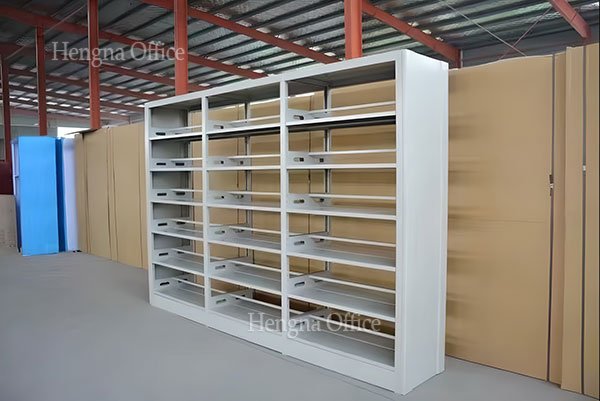
Bolt-together shelving ships flat-packed — cheaper freight, fits through narrow elevators and stairwells. The right choice for orders under 10 bays or buildings with access limitations.
Welded frames cost 15–20% more to ship and need wider delivery paths. But a welded frame stays square permanently. Bolted connections loosen over years of vibration from book carts, foot traffic, and HVAC rumble. In a permanent library installation that will not move for a decade, welded frames are worth the logistics cost.
If you are unsure which your building needs: measure the narrowest door, elevator, and corridor the delivery must pass through. Send those measurements to your supplier before finalizing the order.
Pre-Order Procurement Checklist
- Floor load rating confirmed by structural engineer for fully loaded shelving weight ✓
- Steel gauge specified in writing as a number, not a phrase like “heavy duty” ✓
- Adjustable shelf rails with 25mm minimum increment ✓
- Powder coat specification sheet with curing temperature and micron thickness ✓
- Frame construction (welded or bolt-together) confirmed compatible with building access ✓
- Leveling feet quoted as included, not a separate line item ✓
- Shelf load rating stated in kg per shelf, evenly distributed ✓
- Warranty terms separated: coating warranty vs. structural warranty ✓
Send us your floor dimensions, book count by size category, and delivery access measurements. We will return a shelving specification matched to your actual collection, not a generic catalog recommendation.