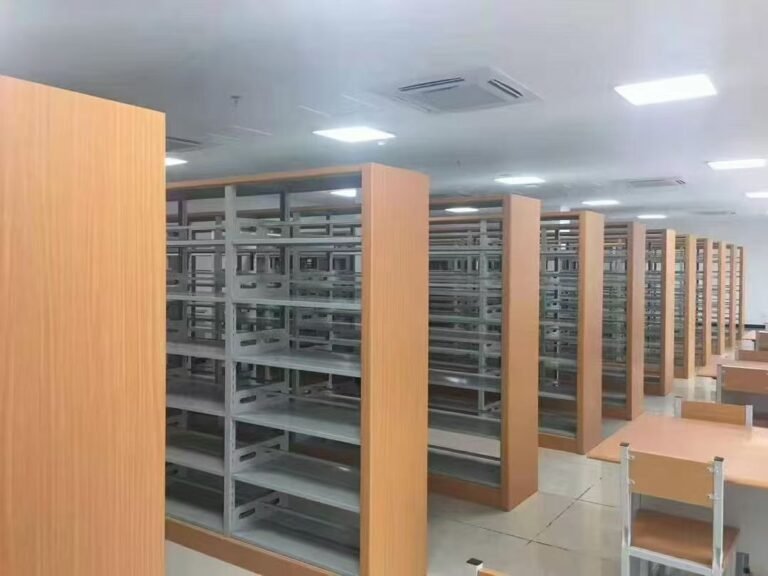
Steel Library Shelving for Universities — Load Ratings and Lifespan for Campus Buyers

University Procurement Is Different
University library shelving gets purchased through a procurement process that demands documentation: load ratings, material specs, warranty terms, references, and lifecycle cost projections. The buying decision isn’t made by one person — it’s built by a committee from the specifications on the page.
This article gives campus procurement teams the numbers and the RFP language they need: what an academic collection actually weighs, what lifespan to project, and which specification points separate a durable system from a low-bid one.
What an Academic Collection Actually Weighs
Academic libraries are heavier than public libraries. The reasons are specific: bound journals, oversized art books, scientific reference sets, archival materials, and a higher ratio of hardcover to paperback than public branches carry.
Working numbers for planning:
- General academic hardcovers: 22-28 per linear meter, roughly 25 kg per meter of shelf
- Bound journals: 12-16 per meter, but 35-45 kg per meter — the heaviest standard load
- Art and architecture folios: 8-12 per meter, 30-40 kg per meter
- Reference sets and encyclopedias: 15-20 per meter, 30 kg per meter
- Microfilm and media cabinets: point loads that vary wildly — check per-cabinet weight
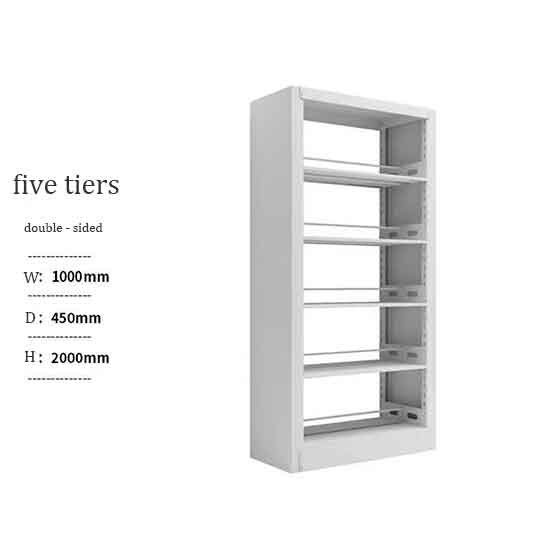
A fully loaded five-tier bay with mixed academic materials lands at 600-800 kg. The floor load calculation should use the heaviest realistic scenario — bound journals on every shelf — not the average.
Load Ratings to Put in the RFP
Three load numbers belong in any university shelving specification:
- Per-shelf rating: 80 kg minimum for academic collections, evenly distributed. Anything lower will bow under bound journal runs.
- Upright capacity: The vertical frame rating — 500+ kg per upright pair for a five-tier bay. This is what keeps a full bay from twisting.
- Point load: At least 40% of the even-load rating. Books aren’t distributed evenly in real life — someone will pack a shelf of heavy journals at one end.
Require the ratings in writing with the test method. “Heavy duty” without a kg number is a marketing phrase, not a specification.
Lifespan Data for Lifecycle Costing
University capital projects need lifecycle cost projections, and shelving lifespan data is thin in most procurement files. Here’s a defensible basis:
- Quality steel shelving (1.2mm uprights, powder-coated): 20+ years of service in academic libraries with normal maintenance
- Wet-painted frames: visible edge wear at 5-7 years, repaint needed at 8-10
- Adjustable shelf mechanisms: infinite service life in practice — the punched rails don’t wear at normal use rates
- Casters on mobile systems: replace at 8-10 years (wear item, budget separately)
The lifecycle cost comparison that matters: a lower-priced system with wet paint and 1.0mm uprights may need replacement at year 12-15, while the quality system runs to year 20+. Spread over the service life, the quality system is usually the cheaper purchase.
Fire and Compliance: The Campus Angle
University libraries carry specific compliance considerations:
- Non-combustible construction: Steel shelving keeps fire load low compared to timber — relevant in multi-storey library buildings and heritage structures.
- Aisle clearance: Local fire codes set minimum aisle widths and require access for inspection. Confirm the layout meets them before ordering.
- Mobile shelving safety: If the project includes compact shelving, require aisle locks, floor sweep sensors, and end stops in the spec — mechanical safety features are part of procurement compliance.
- Accessibility: Reach ranges for wheelchair users affect shelf height selection for accessible zones.
Include the relevant code references in the RFP rather than vague “compliance with local codes” language — it forces bidders to address them explicitly.
Mobile vs Static for Campus Libraries
University libraries use both, and the split follows the collection’s access pattern:
Static shelving for open stacks that students browse directly — reading rooms, reserve collections, new book displays. Patrons need free access to every aisle at all times.
Mobile compact shelving for closed stacks — archives, journals older than the current decade, special collections, storage floors. Staff retrieve on request, so the single-aisle tradeoff is invisible to patrons.
Most research libraries run a 70/30 to 60/40 split: the majority of shelving static in open areas, compact units for the growing closed-stack archive. The ratio depends on the collection’s growth rate and the building’s expansion constraints.
RFP Checklist for Campus Procurement
- Per-shelf load rating in kg with test method stated (80 kg minimum)
- Upright gauge and material: 1.2mm cold-rolled steel minimum
- Coating spec: powder coat, curing temperature, thickness in microns, pre-treatment process
- Adjustable shelves with 25mm increments, tool-free
- Warranty: structural 10 years, finish 5 years minimum, stated separately
- References: minimum 3 academic library installations in the past 5 years
- Delivery and installation schedule tied to the academic calendar (summer installation preferred)
- Spare parts availability: clips, panels, leveling feet stocked for 10 years
- Sample panel submission before order confirmation
- Installation crew certification and safety documentation
Working the Academic Calendar
Installation timing is a procurement decision as much as a logistics one. Library shelving installs produce noise, dust, and blocked aisles — acceptable in summer, painful during finals week. Universities that plan shelving work for June-August avoid disrupting the highest-traffic periods of the academic year.
Ask suppliers for installation scheduling flexibility before the RFP closes; a system that installs in 3 weeks during summer beats a marginally cheaper one that installs in 6 weeks across term time.
Planning a campus library shelving project? Send us the RFP draft and collection data — we’ll respond with a specification-matched quote and reference installations you can call.
Frequently Asked Questions
What is the typical lead time for campus shelving projects?
Plan 6-8 weeks from order confirmation to installation for standard systems: 2-3 weeks production, 1-2 weeks shipping, 3-4 days installation. Custom finishes or large orders add 2-3 weeks. Start the procurement process 3 months before the intended install window to leave room for approval cycles.
Can shelving be installed during term time?
Yes, with zones. Night and weekend installation is standard practice for occupied libraries — crews work after closing hours and seal off each zone. The cost runs 15-25% above daytime installation. Many universities prefer summer shutdown work instead, which is cheaper and faster.
How do I compare quotes from different suppliers?
Build a comparison sheet with four columns: per-shelf load rating, upright gauge, coating specification (curing temperature and thickness), and warranty terms. Price goes in a fifth column. The supplier with the lowest price and the thinnest spec is rarely the cheapest over 20 years. Require all five data points in the bid format.
What spare parts should I order with the initial system?
Order 5% of clips and leveling feet, 10% of shelf panels, and one complete spare upright per 50 bays. Also request the supplier’s parts price list and confirm availability for 10 years. Spare parts after the fact cost 2-3 times the initial order price.
Do universities usually choose mobile or static shelving?
The pattern is a split: open stacks static, closed stacks mobile. Research libraries typically run 60-70% static in public areas and 30-40% mobile for archives, journals, and special collections. The ratio depends on collection growth rate and whether the building can expand.