Single-Sided vs Double-Sided Library Shelving: Which Steel Bookcase Layout Fits Your Space?
When a school librarian tells you their biggest headache is students circling the same aisle three times unable to find a book, the problem is rarely the books themselves. More often than not, it is the shelving layout that was decided at the planning stage and never questioned again.Library shelving is not a one-size-fits-all purchase. The choice between single-sided and double-sided steel bookcase layouts is one of the first decisions you will make, and it shapes everything that comes after — traffic flow, storage density, accessibility, and long-term maintenance costs.
This article breaks down the real-world differences so you can make the call that actually fits your space.
What Is Single-Sided Library Shelving?
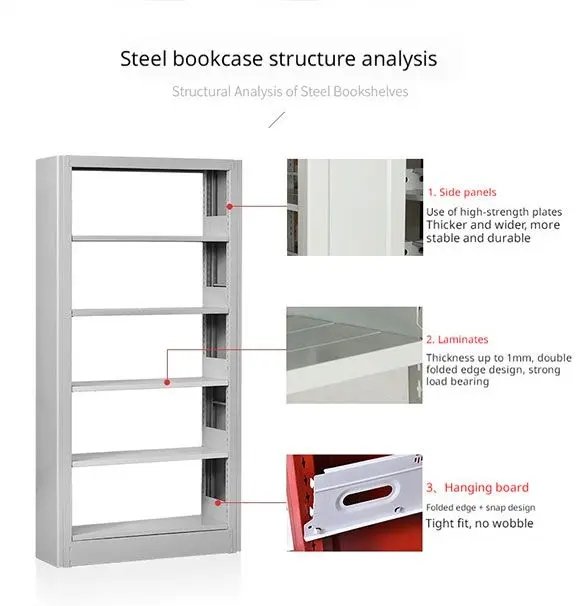
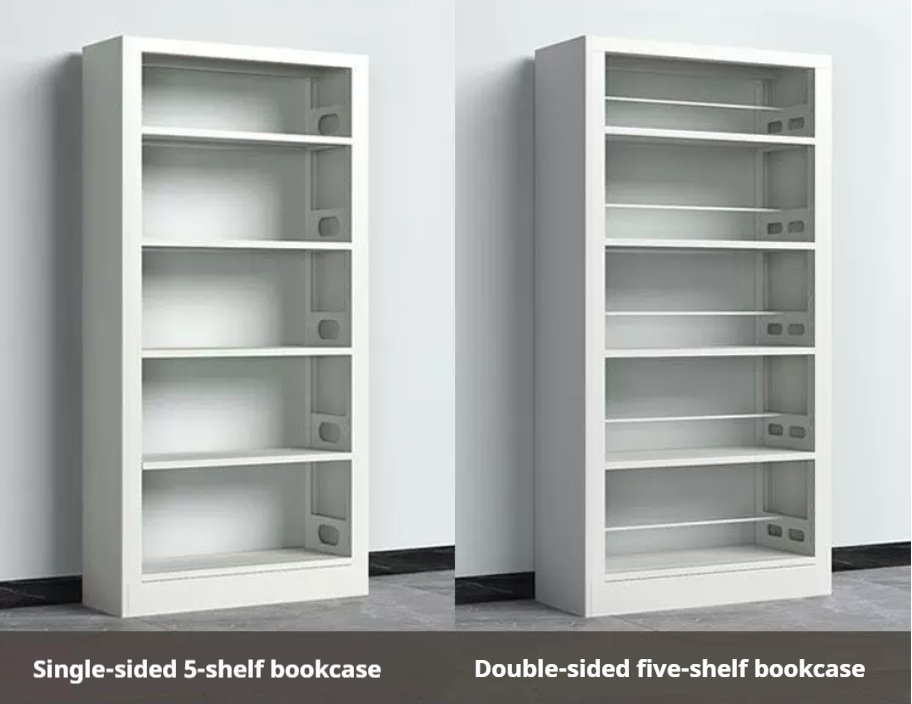
Single-sided library shelving has one back panel. You access books from one side only; the other side sits against a wall or walkway.
These units are typically freestanding or anchored to a wall. They work well as perimeter shelving along library walls or in zones where you need a clear circulation path on one side.
Common in: school libraries with limited floor space, reading corners, and archival rooms where one-directional traffic is already built into the architecture.
What Is Double-Sided Library Shelving?
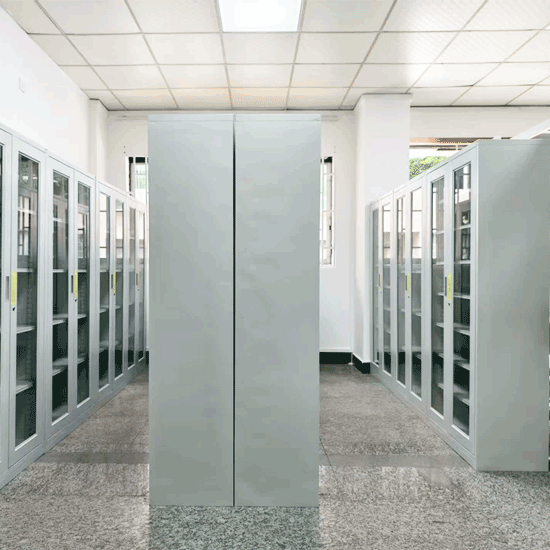
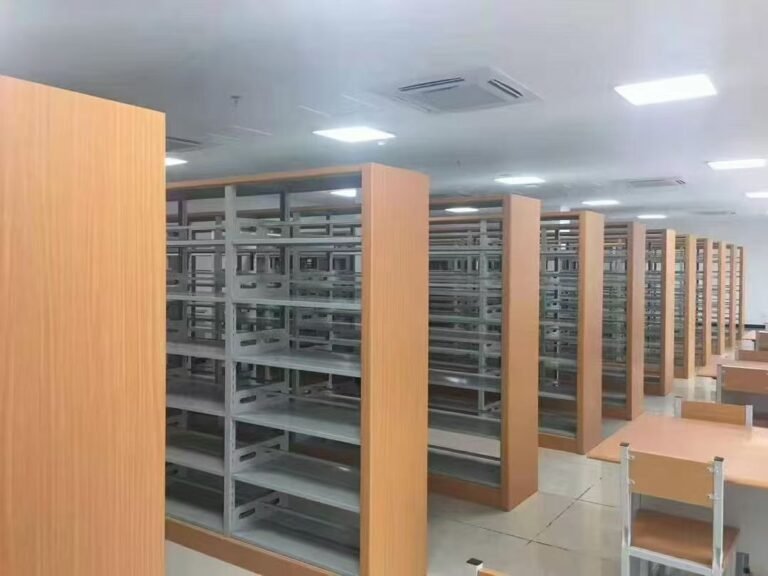
Double-sided library shelving has two back panels and is accessed from both sides. Each unit essentially functions as two back-to-back single-sided rows.
The key implication is that you need aisles on both sides to access the shelves — which eats into your floor plan. In return, you get significantly higher storage density per square meter.
Common in: large public libraries, university research libraries, and dewey decimal classification systems where maximum book capacity is the priority.
Single-Sided vs Double-Sided Library Shelving Comparison
Before diving into trade-offs, here is a direct comparison:
| Factor | Single-Sided | Double-Sided |
|---|---|---|
| Storage density | Lower | Higher |
| Floor space required | Less per unit | More per unit |
| Accessibility | Easier — one access side | Requires aisles on both sides |
| Best for narrow spaces | Yes | No |
| Student/patron safety | Fewer collision points | More aisle transitions |
| Layout flexibility | Higher | Lower |
| Initial cost | Lower | Slightly higher |
| Maintenance | Simpler cleaning | Dusting two back panels |
The Core Trade-Off: Space vs Density
This is the central tension.
Double-sided shelving stores more books in the same footprint. If you have 500 square meters and need to shelve 80,000 volumes, double-sided rows are hard to argue against.
But density is only half the equation. If your students are navigating those dense rows with backpacks, during passing periods, or in a building where accessibility standards apply, a double-sided layout that looked great on paper becomes a daily bottleneck.
Single-sided layouts sacrifice some storage density but give you wider aisles, clearer sightlines, and a layout that behaves better when the library is full of people — which is most of the time.
Decision Framework: Ask These Three Questions
1. Who is using the library, and when?
If your primary users are young children — K-3 students who move in groups, pull chairs behind them, and need constant supervision — single-sided layouts with wider aisles reduce supervision load significantly.
If your users are older students or adult patrons who navigate independently, double-sided density becomes more viable.
2. What is your traffic flow pattern?
Single-sided shelving works best when you have a natural one-way or circular flow: enter, browse perimeter shelving, move toward the center, exit.
Double-sided works when you have defined aisle lanes — like a supermarket layout — where patrons are comfortable moving between parallel rows.
If your library has irregular shapes, pillars, or mixed-use zones, single-sided units along the perimeter with a central display area will almost always outperform double-sided rows forced into an awkward floor plan.
3. What is your growth horizon?
Double-sided layouts are harder to reconfigure. Once you commit to a grid of back-to-back rows, adding a new section or expanding the layout means disrupting existing aisles.
Single-sided units are modular. You can relocate perimeter shelving, rotate a row to create a new browsing nook, or add a single unit without re-engineering your entire floor plan.
If your collection is still growing and you are not sure what the library will look like in five years, single-sided shelving gives you that flexibility.
The Hybrid Approach Worth Considering
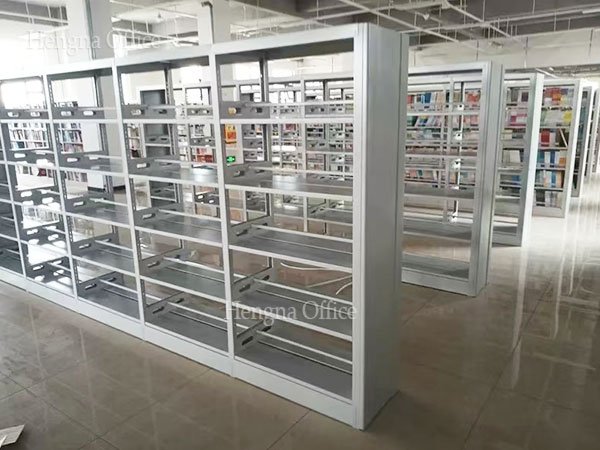
Many libraries that thought they had to choose one or the other end up with a hybrid: single-sided perimeter shelving along the walls and double-sided rows in a designated deep-storage zone in the center.
This works because the perimeter — where natural light is best and students most often browse casually — benefits from open sightlines. The center zone, which students visit intentionally to find a specific title, can handle tighter rows.
Steel bookcase systems from manufacturers that offer both configurations make this straightforward to plan. You can mix unit types in the same order, which also simplifies your spare parts situation down the line.
Steel Construction Matters for Both Types
Regardless of which layout you choose, the material matters.
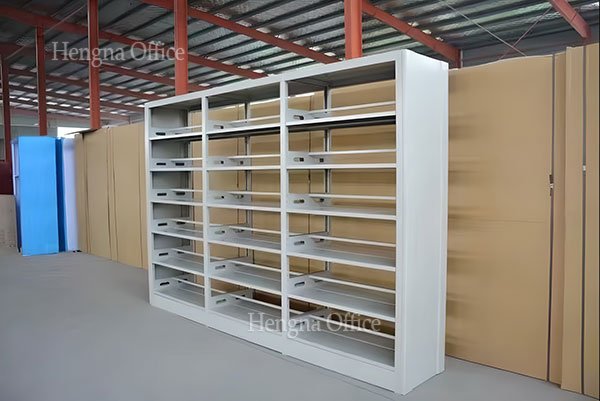
Cold-rolled steel shelving handles the load that library books impose over years — heavier reference volumes, encyclopedias, bound journals — without the gradual sagging you see in particle-board units. Steel also resists the humidity fluctuations that occur when libraries are heated in winter and left closed in summer.
Powder-coated finishes protect against surface scratches from book carts and reduce ongoing maintenance. If the library is in a coastal city or an older building with less climate control, a galvanized or stainless option may be worth discussing with your supplier.
Making the Call
There is no universally correct answer. The school library with 200 students and a 600-square-meter footprint makes a different call than the county public library with 40,000 annual visitors and a building that was designed around a central atrium.
What you should not do is make the decision based on catalog photos that show empty, perfectly lit shelving rows. A library is never empty. The layout that performs best is the one that works when the space is full of people pulling books, pushing chairs, and navigating between rows during peak hours.
If you are currently in the planning phase and weighing your options, start with your traffic flow pattern. From there, the density question answers itself fairly quickly.