Law Office File Cabinet – 3-Drawer Vertical Steel Unit with Full Extension Drawers, Letter Size Compatible
Three Problems That Drive Law Firms Crazy About File Cabinets
File cabinets all look the same. But in a law firm, the difference shows up fast.
Law firms deal with case files, client records, evidence documents, contracts, settlement agreements—files that pile up, can’t get misplaced, and definitely can’t get lost. Many law office managers don’t think much when buying file cabinets. Just grab a few and make do. Then a year or two later, the headaches start.
Problem #1: Drawers only pull out halfway, can’t reach the back files
This is the most common complaint. Case files keep growing. Each case from intake to closing has at least a dozen documents, sometimes hundreds. A lawyer needs an old evidence file, opens the drawer, and it’s packed tight. To get the one in the back, you have to pull out the front ones first, dig through, then stuff them back in.
When it’s urgent—court tomorrow, suddenly need a piece of evidence from two years ago—that’s panic mode. 30 minutes flipping through one drawer, still can’t find it. The judge is waiting, the client is calling, and the file is buried somewhere in the back of a drawer that only pulls out halfway.
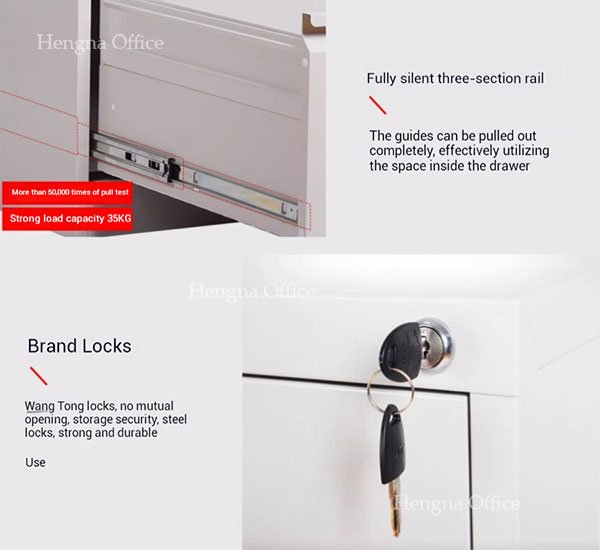
Full extension slides solve this. Regular cabinets pull out about halfway—maybe 25-28cm of a 52cm drawer. The back half stays inside. You can’t see it, can’t reach it without leaning over the cabinet and stretching your arm. Full extension slides pull out the entire 52cm depth. The whole drawer is in front of you. Every file visible, every file within reach.
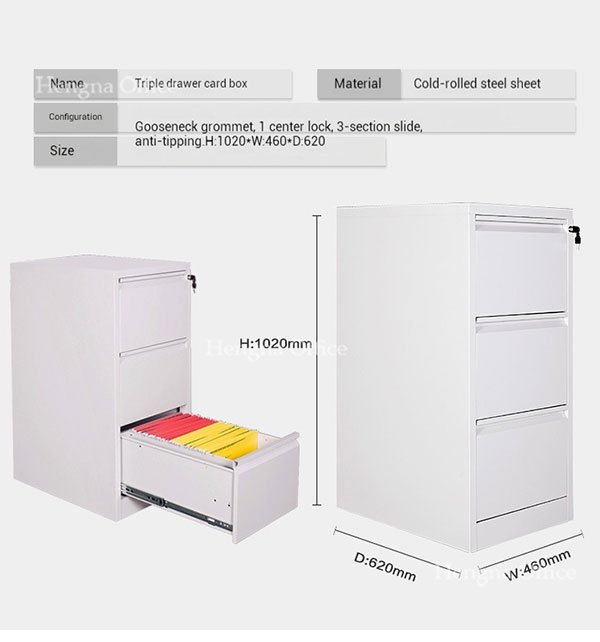
In a law firm, this has real practical value. Case files can be organized by date with the newest ones in the back. One pull and they’re in your hand. No digging, no searching, no panic before court.
Problem #2: Locked but not secure
Many file cabinet locks are a joke. The mechanism is so simple you can pop it open with a paperclip. Or worse—keys are interchangeable. Your key opens someone else’s cabinet. Their key opens yours. In a building with fifty law firms, that’s a real problem.
In a law firm, cabinets hold client confidences, case strategies, settlement agreements, financial records, privileged communications. Leak those, and you’re looking at client complaints, malpractice claims, reputation damage, maybe even legal liability. It’s not just inconvenient—it’s dangerous.
Central lock system with brand-name hardware at least guarantees one thing: one key locks all three drawers simultaneously. The lock is from Wang Tong, a professional lock manufacturer. Steel core, hardened mechanism, low cross-key rate. What that means: your key opens your cabinet, not the one next door. Not the one upstairs. Not the one in the building across the street.
For sensitive files—case materials, client records, personnel files—that’s at least one real layer of protection. Lock once before leaving, all three drawers secured. No checking each one. No wondering if you forgot something.
Problem #3: Wrong size
North American law firms use Letter (8.5″ x 11″) and Legal (8.5″ x 14″) file folders. That’s the ANSI standard, used by every law firm, every court, every government agency in the US and Canada.
But many imported file cabinets have interior widths that are too narrow. The outside dimensions look right, but the steel thickness and slide mechanism eat up space inside. Interior ends up around 380mm or less. A Letter folder is 279mm wide—it fits, but barely. There’s 50mm of clearance on each side, which sounds like enough, but in practice the folder rubs against the walls. It drags, catches, jams. Pull it out fast and the file gets stuck. Push it back and the folder crumples.
Legal folders are 356mm wide. In a 380mm interior, there’s 24mm total clearance—12mm on each side. That’s less than half an inch. The folder barely fits. Open and close the drawer a few times, the folder starts to bend and tear.
This cabinet is designed specifically for Letter size. The interior width is 400-415mm, giving Letter and Legal folders room to move. Folders slide in and out smoothly, no jamming, no forcing. Hanging files work properly—the hooks sit on the side rails, slide along when the drawer opens, stay in place. Each drawer holds 200 empty hanging files. Three drawers, 600 total. Enough for a mid-sized firm.
What’s the Point of Full Extension Slides?
Many people don’t get the difference between “full extension” and “regular” slides. Both open, right? Both hold files. Why does it matter?
The difference is simple but significant. Regular slides only pull out about half the drawer depth. If you have a 52cm deep drawer, regular slides might pull out 25-28cm. The remaining 24-27cm stays inside the cabinet. You can’t see it, can’t reach it without climbing over your desk and stretching your arm into the cabinet.
Full extension slides pull out almost the entire drawer length—52cm for a 52cm drawer. The whole drawer is in front of you. Every file visible, every file within reach.
Here’s what that looks like in practice:
You’re working on a case from 2021. The client calls, needs a document from the original intake file. With a regular cabinet, you open the drawer and see files from 2024, 2023, maybe late 2022. The 2021 file is somewhere in the back. You start pulling files out, stacking them on the floor, digging through. Five minutes later, you find it. Now you have to put everything back.
With full extension, you pull the drawer all the way out. The 2021 file is right there, third from the back. You grab it, close the drawer. Done. Thirty seconds.
Practical law firm scenarios:
- Case files by date: Newest files in the back, one pull and they’re in hand. No digging through older files.
- Client files alphabetically: 26 letters, one hanging file per letter, direct access. Pull the drawer, find the letter, grab the file.
- Emergency retrieval: Judge calls for evidence during trial, you have 30 seconds to find it. Full extension means you can.
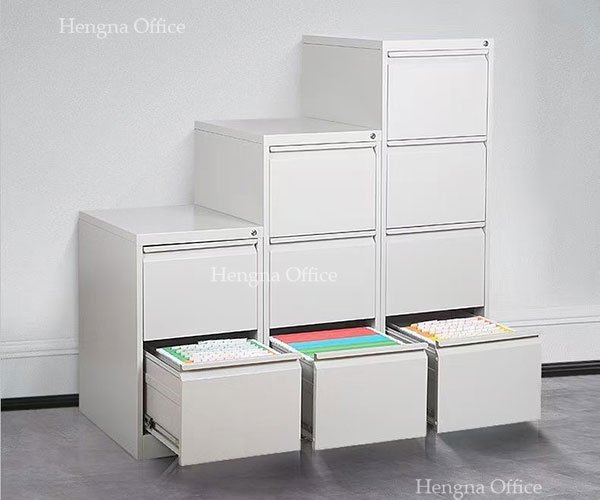
The slides are three-section ball bearing. Smooth pull, stable push, no wobbling. Each drawer holds 35kg—about 200 files with papers inside. Full load, still slides smoothly. Not the cheap kind that jams halfway or sags under weight.
One Key Locks Three Drawers
Central lock system is simple in concept, but it solves a real problem.
Regular file cabinets have separate locks for each drawer. Three drawers, three keys. Before leaving the office, you have to check each one. Did I lock the top? The middle? The bottom? Where’s the third key? Did I leave it in the drawer?
Busy days, distracted moments, one drawer gets left unlocked. Next morning you notice, and your heart sinks. Who was in the office last night? Did anyone open that drawer? What was in there?
Central lock is one key, all three drawers. The lock slot is on the top of the cabinet, right above the top drawer. Insert the key, turn it, all three drawers lock simultaneously. Unlock in the morning, one turn, all three open.
The lock hardware is from Wang Tong, a professional lock manufacturer that supplies commercial furniture companies. Steel core mechanism, hardened components, designed for heavy use. Low cross-key rate means your key doesn’t open someone else’s cabinet, and their key doesn’t open yours. That’s not true for generic locks—those often have cross-key rates of 1 in 50 or higher. Your key might open every fiftieth cabinet in the building.
For law firms handling sensitive information, that matters. Client confidences, case strategies, personnel records, financial documents—these need real protection, not decorative locks.
Letter Size Actually Fits
North American law firm folder standard is Letter and Legal size. ANSI standard, used by courts, government agencies, and law firms across the US and Canada. Letter is 8.5″ x 11″ (216mm x 279mm). Legal is 8.5″ x 14″ (216mm x 356mm).
Here’s why cabinet size matters:
Many imported cabinets have interior width problems. The exterior dimensions are standard—about 460mm wide, looks right in the catalog. But the steel walls are thick, the slide mechanism takes space, the drawer front overlaps the cabinet body. Interior width ends up around 380mm or less.
A Letter folder is 279mm wide. It fits in 380mm—but barely. There’s 50mm of clearance on each side, which sounds like enough, but in practice the folder rubs against the walls. It drags, catches, jams. Pull it out fast and the file gets stuck. Push it back and the folder crumples.
Legal folders are 356mm wide. In a 380mm interior, there’s 24mm total clearance—12mm on each side. That’s less than half an inch. The folder barely fits. Open and close the drawer a few times, the folder starts to bend and tear.
This cabinet’s interior is 400-415mm. Letter folders have 120mm of clearance. Legal folders have about 60mm. Folders move freely, slide in and out, no catching, no forcing. The drawer closes smoothly, opens smoothly. Files stay intact.
Hanging files work properly too. The drawer is a “bucket” design—side panels extend all the way to the bottom, forming a complete box. Hanging file hooks sit on the side rails and slide along when the drawer opens. They don’t fall off, don’t bunch up. Each drawer holds 200 empty hanging files. Three drawers, 600 total.
Anti-Tip Isn’t Optional
File cabinets tip over. It happens more than people think.
Three drawers open at once, center of gravity shifts forward. The cabinet leans. If it’s not heavy enough, if the base isn’t stable, if the floor is slightly uneven—it goes down. A falling file cabinet weighs 40-60kg. That’s 100-130 pounds of steel coming at you or your colleagues.
This cabinet has a built-in anti-tip mechanism. It’s a mechanical interlock system. Here’s how it works: when you open the second drawer, the first one gets blocked and can’t be pulled out further. Open the third drawer, the first two get blocked. Only one drawer can be fully extended at a time. That keeps the center of gravity stable and the cabinet upright.
This isn’t an add-on wire bracket that you attach to the wall. It’s built into the cabinet design. Can’t forget to install it. Can’t install it wrong. Can’t remove it and lose it. It’s always there, always working.
For law firms, government offices, anywhere with safety compliance requirements, anti-tip is almost mandatory. OSHA standards require it for commercial furniture. BIFMA X5.9—the safety standard for office file cabinets—requires it. This cabinet meets those standards.
law office file cabinet Specifications
| Parameter | Value |
|---|---|
| Height | 1020mm (40 inch) |
| Width | 460mm (18 inch) |
| Depth | 620mm (24 inch) |
| Full Extension Depth | 520mm (20.5 inch) |
| Material | Cold-rolled Steel |
| Finish | Powder Coating |
| Colors | White / Black |
| Folder Compatibility | Letter / A4 / Legal |
| Lock | Central Lock System |
| Load Capacity | 35KG per drawer |
| Hanging File Capacity | 200 per drawer |
Who Is This Cabinet For?
Good for:
- Law firms, legal consultancies—lots of case files, high confidentiality requirements
- Corporate legal departments—contract management, litigation archives
- Government legal departments—public records, compliance requirements
- Accounting firms, financial advisors—client documents, audit files
- Medical offices—patient records, insurance files
- Any office with frequent file access and security needs
Not for:
- Ultra-low budget situations where replacing cabinets every two years is acceptable
- Open archives that don’t need locks or security
- Occasional light storage where file access isn’t frequent
- Home offices that only store a few dozen files
FAQ
Can drawers pull all the way out? Yes. Full extension slides pull out 52cm depth. Entire drawer is outside the cabinet. Back files are within reach, no leaning or stretching.
Fits Letter size folders? Yes. Interior width is 400-415mm. Letter (279mm), Legal (356mm), and A4 (297mm) all fit with room to spare. Folders slide freely, no jamming.
Is the lock secure? Central lock system—one key locks all three drawers. Wang Tong brand lock with steel core mechanism. Low cross-key rate means your key opens your cabinet only, not others.
Need assembly? Two versions available: assembled version is ready to use out of the box; KD (knock-down) version requires assembly but costs less to ship.
Will it tip over? Built-in anti-tip mechanism. Mechanical interlock prevents multiple drawers from opening fully at the same time. Cabinet stays stable.
How many files fit? Each drawer holds 200 empty hanging files. Three drawers, 600 total. For letter-size files with average thickness, that’s years of storage for most law firms.
What colors are available? White and black standard. Both are powder-coated finish—durable, scratch-resistant, professional appearance.
Does it fit under a desk? Height is 1020mm (40 inches). That’s taller than most desks. This is a standalone vertical file cabinet, designed to sit beside a desk or against a wall. For under-desk storage, look at pedestal-height cabinets.
Why This One?
File cabinet prices vary enormously. Cheap ones cost $40-70. Premium brands like Hon or Hirsch cost $200-300 per cabinet. That’s a huge range.
The cheap ones have problems:
- Slides jam after two years of regular use
- Locks are decorative—easily picked or bypassed
- Dimensions don’t match standard file folders
- Steel is thin, bends under weight, looks cheap
- No safety features, no compliance certifications
Replace a cheap cabinet twice, you’ve spent $120-140. Still have a cheap cabinet. Still have the same problems.
The premium brands are good:
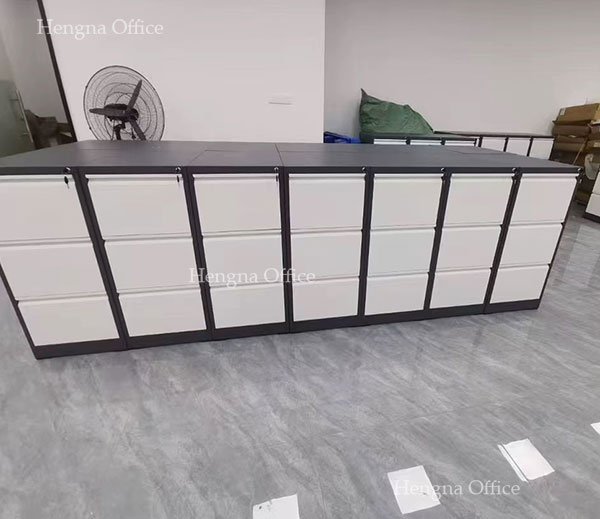
This cabinet sits in the middle. Commercial-grade quality—better than home-use cheap cabinets, more affordable than premium brands. Here’s what that means:
Three things:
- Full extension slides: Files reachable, no digging. Slides tested for durability under real commercial loads.
- Central lock: One key, three drawers, brand-name hardware. Security that actually works.
- Letter size fit: Interior dimensions designed for North American standard folders. Files fit, hang properly, move freely.
Three things. Each one done right. Not perfect—there’s always a trade-off at this price point—but solid, reliable, professional.
For a law firm that needs functional file storage without the premium brand markup, that’s the value proposition.
Contact for bulk orders, OEM customization, or dealer pricing.