
Boltless Steel Storage Racks — Snap Together in Minutes, No Tools, 200kg/Shelf for Garage
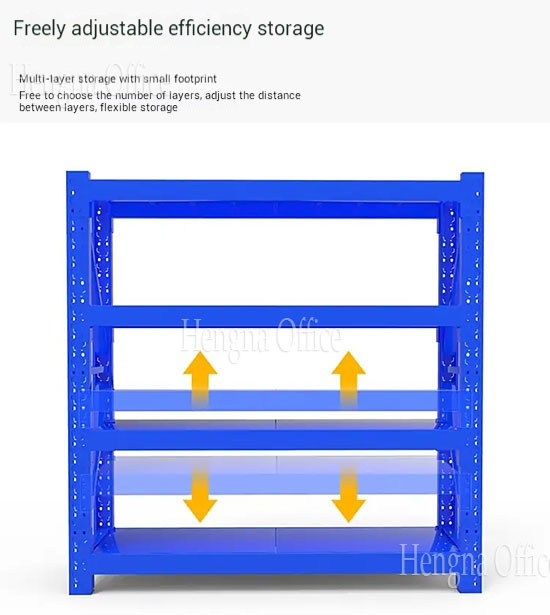
Last month I helped a friend clean out his garage before moving. He’d stacked five plastic totes of tools, two lawn mowers, and a tangle of extension cords on a single wooden shelf that sagged in the middle. When we lifted the shelf off, the load rating written on the sticker said 40 kg. He’d been putting four times that on it. He asked me what to buy next, and I gave him the same answer I give every home mechanic and small warehouse owner: a boltless steel storage rack, snap-together, no tools.
This guide is the practical version of that answer. It covers what boltless actually means, how much the 200 kg per shelf figure really translates to in real life, and what to check before you order one for your garage or workshop.
What “boltless” means, and why it matters in a garage
A boltless steel storage rack is a shelving unit held together by butterfly clips (some call them rivet clips or snap clips) that lock into pre-drilled slots on the upright columns. You slide the beam into the slot, snap the clip into place, and the shelf sits on top. No bolts, no nuts, no drill, no torque wrench. The whole thing assembles from a flat pack with nothing but your two hands.
That matters more than most people expect. In a garage, you’re usually assembling near a car that’s parked, with kids or dogs around, and you don’t want a 20-minute job turning into an hour with a ratchet set. Boltless racks assemble in minutes and can be knocked down again if you move house or want to reconfigure the layout.
What does 200 kg per shelf really mean?
Here’s where buyers get tripped up. “200 kg per shelf” is the load rating for an evenly distributed load across the full shelf, on a level floor, with the rack properly assembled. It is not the same as “you can drop 200 kg in one corner.” Real-world loads are rarely perfectly even.
- Evenly stacked boxes, bins, and totes: 200 kg per shelf is comfortable.
- One heavy, concentrated item (a bench grinder, an engine block): keep it near a beam and below about half the rating.
- Long, cantilevered items (pipes, lumber sticking out past the edge): those reduce the safe load a lot. Store them flat and short.
For a typical garage, that 200 kg per shelf rating means you can load each level with a full stack of standard moving boxes or a set of car tires without worry. If you need more, you spread the same weight across two shelves instead of cramming it onto one.
Boltless vs. welded vs. wood: quick comparison
| Factor | Boltless steel rack | Welded steel rack | Wood shelf unit |
|---|---|---|---|
| Assembly | Snap-together, no tools, minutes | Comes fully welded, heavy to move | Screwdriver, sometimes drill |
| Disassembly / reconfiguration | Easy, reusable parts | Not reconfigurable | Re-screw, wood can split |
| Load per shelf | Up to 200 kg | Similar or higher | Usually much lower |
| Moisture / garage environment | Powder-coated steel, anti-rust | Steel, check coating | Warps, sags over time |
| Cost to ship flat | Low (flat pack) | High (bulky welded) | Medium |
My honest take after years in this trade: for a garage, workshop, or small storage room, boltless steel wins almost every time. The only place I’d push welded is a heavy industrial bay that never changes layout. Wood I only recommend for light, indoor display use where looks matter more than load.
How many tiers and which shelf spacing?
Most boltless racks come in 3, 4, or 5 tiers. Before you pick a number, measure your tallest item. If you store ladders or a snowblower, you want at least one tall opening. Choose the number of layers by what you’re storing, not by what looks full.
- 3-tier: best when you have a few tall, bulky items and want bigger shelf gaps.
- 4-tier: the sweet spot for most garages — good balance of total space and access.
- 5-tier: for lots of small boxes and bins, but the top shelf gets hard to reach without a step.
Every shelf on a boltless rack is adjustable in height. Loosen, lift, re-snap — you can re-space the shelves in under a minute. That’s the real flexibility advantage: the rack adapts to what you own, not the other way around.
Things to check before you order
- Rated load per shelf — confirm it’s 200 kg (or the figure the seller states), not a vague “heavy duty.”
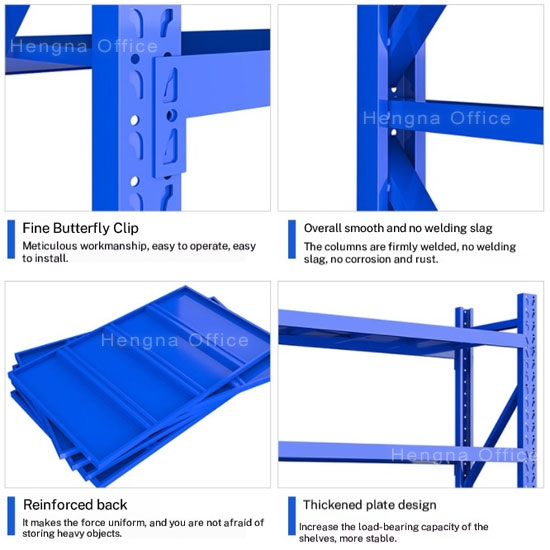
- Coating — look for powder-coated steel. It resists rust and scratches far better than painted metal.
- Beam-to-column clip design — the butterfly clip should snap in cleanly and hold firm; cheap clips wobble.
- Back bracing — a reinforced back keeps the rack stable and stops the whole unit from racking sideways.
- Thickened shelf plate — thicker plate means less bowing under a full load.
- Shipping — flat-pack racks ship cheap and arrive in a few boxes; check the actual dimensions so it fits your space.
- Level floor — a rack on a sloped garage floor is unstable no matter how good it is. Shim the feet.
A quick word on the butterfly clip
The clip is the part most people worry about, so let me put it plainly. A well-made butterfly clip is stamped from steel, snaps in easily, and holds the beam firmly. It is not a cheap plastic hook. The rack only gets more secure as you load it, because the weight drives the beam deeper into the slot. I’ve loaded these racks with engine parts and heavy toolboxes without a single clip letting go.
FAQ
Can I assemble a boltless rack alone?
Yes. Two people make it easier to lift the rack upright, but one person can handle assembly with the unit laid on its side first.
Is 200 kg per shelf enough for a garage?
For almost everything you’d store at home — totes, tools, tires, boxes, small machines — yes. For a single massive item, spread it across two shelves.
Can I adjust the shelf height later?
Yes. Every shelf is adjustable without tools; lift and re-snap the clips to a new slot.
Does the rack rust in an unheated garage?
Powder-coated steel holds up well in a typical garage. If you live somewhere very humid or coastal, keep the rack off damp concrete with a small spacer under the feet.
How much floor space do I need?
Measure the rack’s footprint (usually a standard 800 mm depth × the width you choose) plus a little room to reach the sides. A 4-tier rack around 1800 mm tall fits a standard garage ceiling with room to spare.
Why we’re the people to buy from
We manufacture these boltless steel storage racks in our own factory in Luoyang, China. That means we control the steel grade, the powder coating, and the clip tolerances end to end — and it means flat-pack pricing that importers and home buyers can actually use. If you’re sourcing for a shop, school, or warehouse, or you just want one solid rack for the garage, we can quote a unit or a container.
Measure your space, pick your tier count, and send us your sizes. We’ll confirm the build and ship a rack that goes together in minutes and holds what you put on it.


