
Heavy-Duty Steel Storage Racks for Archive Rooms — Adjustable 4-Level, Hold Up to 200kg/Shelf
I spent a day last week inside an archive room at a county records office. The room was 18 square metres, and the walls were lined with shelves crammed with box files from floor to ceiling. Every time someone needed a file from the back row, two people had to slide a plastic tub out of the way. The shelves weren’t the problem, though — they were. Load ratings on some units said 60 kg. Half the drawers in the front row were holding metal and glass cases, not paper. It’s exactly the situation where people buy the wrong rack.
This guide is for anyone storing archive boxes, drawings, equipment, or records who needs real carrying capacity, not a guess. We’ll cover what a heavy-duty steel storage rack actually handles, how a 200 kg per shelf rating plays out in an archive room, and what to check before you buy. No fluff, just the numbers that matter.
What does “heavy duty” really mean on a steel rack?
“Heavy duty” gets thrown around so loosely it’s nearly meaningless without a number. A heavy-duty steel storage rack has three things a light-duty unit lacks: thicker steel columns and beams, a higher rated load per shelf (in our case up to 200 kg), and reinforced connections that hold under repeated loading and unloading.
For archive rooms, that load rating matters because you’re not storing light paper. Box files filled with paper are denser than people think — a single banker’s box of A4 records can hit 15 kg, and the heavier end of a shelf fills up fast. When you load 200 kg across four levels, you’re storing roughly 800 kg of records in a footprint smaller than a desk. That’s the whole point of archive shelving: pack more per square metre, without the shelves giving out.
200 kg per shelf: how to actually use it
The rating is for an evenly distributed load on a level floor with the rack properly assembled. Treat it that way and you’re fine. Load it badly and even a good rack will complain.
- Evenly stacked archive boxes and file cartons: 200 kg per shelf is safe and comfortable.
- Concentrated single items (a heavy machine part, a tool chest): keep them near a beam and stay below about half the rating.
- Items that overhang the shelf edge: they reduce the safe load a lot. Store them flat and within the footprint.
In practice, one rule covers most archive rooms: distribute the weight evenly, spread heavy items across two shelves instead of one, and never let the load overhang the front edge. Follow that and a 200 kg shelf will hold your records for years.

Why adjustable 4-level beats fixed shelving in an archive
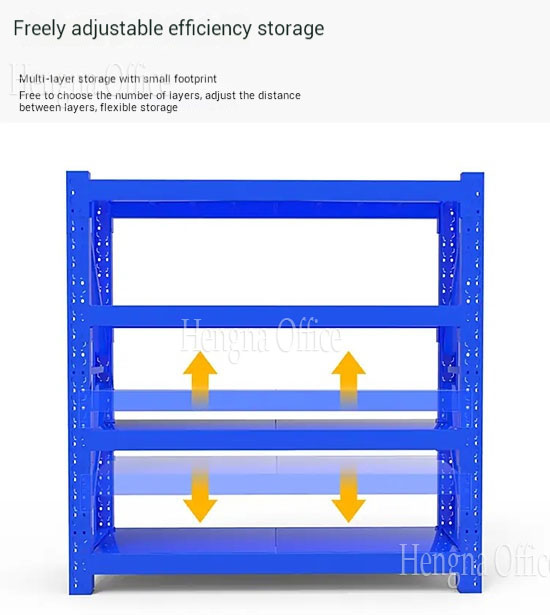
Archives change. You add a new run of records, clear out an old drawer, shift equipment. Fixed shelving locks you into the layout you had on day one. An adjustable 4-level rack lets you re-space the shelves to fit whatever you’re storing now.
- Move a shelf up or down in under a minute — no tools, just lift and re-snap the clips.
- Create one tall opening for drawing tubes or equipment without wasting the rack.
- Reconfigure levels as your storage mix changes instead of buying a new unit.
That flexibility is why I steer archive managers toward adjustable racks: your storage will change, and a rack that changes with it is money saved.
Steel storage rack vs. archive cabinet vs. mobile shelving
| Factor | Steel storage rack | Archive cabinet | Mobile shelving |
|---|---|---|---|
| Load per shelf | Up to 200 kg | Lower, drawer-based | High, but on rails |
| Flexibility | Adjustable levels | Fixed drawers | Fixed bays |
| Cost | Low, flat-pack | Higher | Highest (rails + drive) |
| Footprint efficiency | Good | Good | Excellent (compacts) |
| Best for | Boxes, records, equipment | Files you access by drawer | Large, rarely-accessed collections |
My honest recommendation: for most archive and storage rooms that aren’t huge, a heavy-duty steel rack is the best cost-per-kilo you can buy. Mobile shelving wins only when your collection is big and you access it rarely. Cabinets win only when you genuinely need drawer access to individual files.
If you’re unsure whether 200 kg per shelf is enough for your collection, do a five-minute audit before ordering. Weigh one representative box of records on a bathroom scale — a full banker’s box of A4 files often runs 12 to 15 kg. Multiply by how many sit on a single shelf. Ten of those is 120 to 150 kg, comfortably inside a 200 kg rating. Do the same for your heaviest single item: if it’s a machine or a loaded tool chest, give it its own shelf and stay under half the rating. That quick audit stops you from either overpaying for unused capacity or buying light shelving that bows within a year.
What to check before you order an archive rack
- Confirmed load rating per shelf — get a real number (like 200 kg), not “heavy duty” with no figure.
- Column and beam steel thickness — heavier gauge steel carries more and sags less.
- Clip design and fit — the clips should snap in cleanly and hold the beam firm; sloppy clips wobble under load.
- Back bracing — a reinforced back stops the rack from racking sideways, which is what makes units tip in practice.
- Shelf plate thickness — thicker plate means less bowing under a full load of archive boxes.
- Flat-pack shipping — a 4-level rack ships flat and cheap, and assembles in minutes.
- Level floor — archive room floors are often uneven. Shim the feet and check stability before loading.
A note on loading archive racks safely
Two mistakes cause most archive shelving accidents. The first is overloading the top shelf — people stack everything up high and leave the bottom empty. The second is loading one side only, which makes the rack lean. Load heaviest items on the bottom levels, spread weight across the width, and anchor the rack to the wall if it’s tall and you’re in a seismic or high-traffic area. Do that and a 200 kg rack is a very safe piece of equipment.
FAQ
Can a steel rack hold heavy archive boxes without sagging?
Yes, when it’s rated for the load. A 200 kg per shelf rack with thickened plates holds full box files without the shelf bowing.
Is 200 kg per shelf overkill for a small office archive?
It’s comfortable headroom. Even if you rarely hit it, the thicker build and stable clips make the rack last longer.
Can I adjust the levels after it’s assembled?
Yes. Every shelf moves to a different slot without tools — lift, re-snap the clips, done.
Do I need to bolt the rack to the wall?
For a tall rack in an active room, yes. It’s cheap insurance against tip-over, especially with kids or heavy foot traffic around.
How much does a 4-level rack hold total?
Four shelves at 200 kg each gives you around 800 kg of rated capacity in a footprint roughly the size of a desk. Spread heavier loads across shelves and you’re well within limits.
Why buy from us
We manufacture heavy-duty steel storage racks in our own factory in Luoyang, China. That means we control the steel grade, the powder coating, and the clip tolerances from raw coil to finished unit — and it’s why we can offer flat-pack pricing that works for archives, schools, and warehouses alike. If you’re outfitting a records room or storage bay, tell us your dimensions and what you’re storing, and we’ll size the rack to the load.
Measure your space, list what goes on each shelf, and send it over. We’ll build a rack that holds what you put on it — and re-spaces when your archive grows.


