
High Density Mobile Shelving Systems — Space Savings for Archives Considering the Switch
The Aisle Math Nobody Argues With
Static shelving needs an access aisle in front of every row. Six rows of shelving at 600mm deep need five aisles at 900mm wide — that’s 4.5 meters of aisle for every 3.6 meters of shelving. Run the numbers and over half your archive floor is standing space, not storage space.
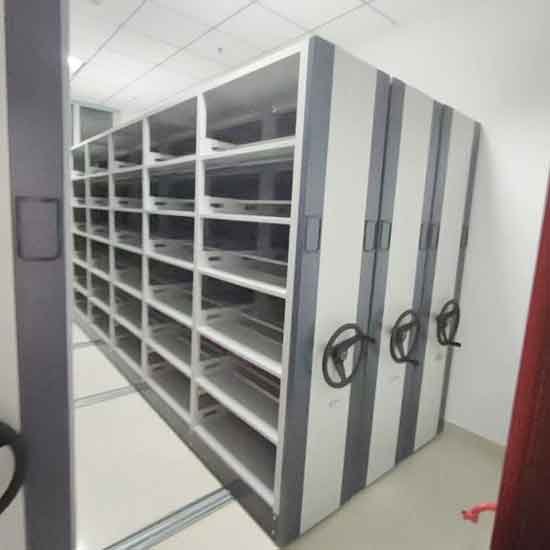
Mobile shelving collapses those aisles. Six carriages sit on floor rails, touching when closed, and the single active aisle moves to whichever row you’re accessing. The storage footprint stays the same; the aisle requirement drops from five aisles to one. Most installations see usable capacity rise by 60-100% in the same room.
That’s the headline. The rest of this article is about the questions nobody asks before signing: how to calculate your own savings, when the savings don’t materialize, and what the switch actually costs in time and disruption.
How to Calculate Your Own Space Savings
Skip the supplier’s sales sheet and run the calculation yourself. It takes ten minutes with a tape measure:
- Measure your room’s usable floor area in square meters.
- Count the current shelving: number of rows, row length, shelf tiers per bay.
- Calculate current linear meters of storage (rows × length × tiers).
- Estimate aisle share: measure total aisle width vs total floor width.
- For mobile: keep the same rows and tiers, replace the aisle layout with one 900mm aisle plus rail clearance.
- New linear meters = current rows × length × tiers, minus whatever rows you lose to rail end-stops (usually one partial row).
Concrete example: a 100 sqm records room with 12 static rows of 2.4-meter shelving, 5 tiers per bay. Static linear meters: roughly 144. Aisle share: about 55%. Converted to mobile with 11 carriages of the same size: roughly 132 linear meters in the same footprint — a 90%+ gain over static, because the aisle space converts to storage.
The percentage varies with room shape. Long narrow rooms gain less (the one aisle still runs the full length). Square rooms gain more. Run your own numbers before believing anyone else’s.

When the Savings Don’t Show Up
Mobile shelving isn’t automatically better. Three situations produce disappointing results:
- Low-density storage: If your archive is only 40% full, you’re paying for density you don’t need. Fill the static shelving first; mobile is a capacity solution, not a tidiness solution.
- Small rooms under 20 sqm: Rails, end panels, and the safety lock mechanism consume fixed space. In very small rooms, the overhead can eat most of the gain.
- High-frequency random access: If staff retrieve from random rows 50+ times a day, the time spent opening and closing the aisle adds up. Static shelving with wide aisles may serve that workflow better.
There’s also the floor question. Mobile shelving concentrates weight at the rail positions. If your floor slab is under 150mm or sits on poor subgrade, you may need structural reinforcement before installation — a cost that changes the payback math. Get an engineer’s look at the floor before you commit.
What the Switch Actually Involves
The realistic timeline for a mid-size archive: 3-4 weeks from order to operational, not counting your own preparation.
- Week 1: Site survey, floor verification, rail layout design, order confirmation
- Weeks 2-3: Manufacturing and delivery
- Week 3: Empty the affected rows, prep the floor (leveling compound if needed, carpet cut-back)
- Week 4: Rail installation (1-2 days), carriage assembly (2-3 days), shelving mount, safety system verification, staff training
Budget for one big disruption: every document in the converted rows moves out and back. Most archives schedule this during a quiet period and hire temporary help for the move. It’s a weekend-to-a-week of disruption, once.
Cost per Linear Meter: Mobile vs Static
Comparing per-linear-meter cost only makes sense when you include the floor. Static shelving costs less per meter of equipment, but delivers fewer meters per square meter of floor. Mobile shelving costs 1.5-2 times more per linear meter of equipment, yet roughly doubles the meters per floor area.
The decision framework that matters: what would the alternative space cost? If the archive is in a building that’s out of space, the comparison is mobile shelving vs renting off-site storage or building an extension. In high-rent urban areas, mobile shelving pays back within 12-24 months of avoided rent. In a cheap rural building with empty rooms, it may never pay back.
Run the comparison on your own numbers: annual cost of the alternative space divided by the meters of storage you need. If that number exceeds the annualized cost of mobile shelving, the switch makes financial sense.
Archives That Made the Switch
A university records office with 10,000 linear meters in a heritage building converted 800 sqm of static shelving to mechanical-assist mobile units. Capacity went from 10,000 to 16,500 linear meters in the same footprint. Their retrieval volume didn’t change — roughly 60 pulls a day — which is well within the comfort range for mechanical assist.
A government registry, by contrast, stayed static. Their staff pull records continuously through the day, across every row, and the building was full of structural columns that broke up any long rail runs. The math didn’t favor them, and they were right not to convert.
The pattern: mobile shelving rewards institutions with growing collections, stable layouts, and expensive floor space. It punishes high-frequency random access and awkward floor plans. Decide which side of that line you’re on before you get quotes.
Send us your room dimensions and current row layout, and we’ll run the density calculation both ways — static and mobile — so the decision is on paper, not on a sales call.
Frequently Asked Questions
Can mobile shelving be installed on carpet?
Not directly. Rails must sit on bare concrete — carpet gets cut back at the rail positions. Vinyl and epoxy flooring can stay in place, with rails mounted on top. If the room has carpet, budget a day of carpet work before rail installation.
What happens during a power outage with mechanical systems?
Nothing — that’s the advantage. Mechanical assist uses a hand wheel and gearbox, no electricity anywhere in the system. The archive keeps working through outages. Electric systems need a manual override crank, and opening a row manually on an electric carriage is slow, typically 2-3 minutes of cranking.
Do mobile systems need special insurance?
Standard building insurance covers mobile shelving as fixtures once installed, but it’s worth confirming the carriage weight is declared in the building’s floor load assessment. Some insurers ask for the rail anchoring specification. Your installer should provide both documents.
How much does mobile shelving cost per linear meter?
The honest range is broad because carriage size and drive type move the number. Mechanical assist systems typically run 1.5-2 times the per-meter cost of equivalent static shelving. The counterbalance is density: the same floor delivers roughly double the meters, so per-meter-of-floor cost is usually lower with mobile. Get quotes on both configurations and compare that way.
How long does a mobile shelving installation take?
A typical 10-12 carriage system installs in 3-4 working days with a three-person crew: rail anchoring and leveling day one, carriage assembly days two and three, shelving mount and safety verification day four. Your own preparation — emptying rows and floor prep — adds a few days before the crew arrives.

![High-Density Manual Mobile Shelving for [Institutional Records Management] & Public Storage](https://getstorshelving.com/wp-content/uploads/2026/02/RER_fixed.jpg "High-Density Manual Mobile Shelving for [Institutional Records Management] & Public Storage")