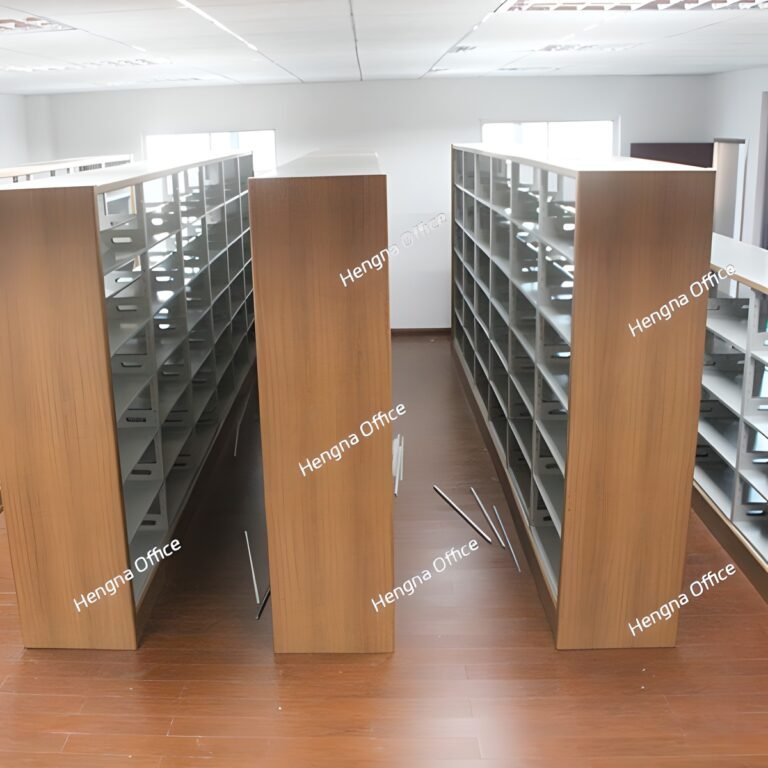
Double-Sided Steel Bookshelf — 5 Tiers, Load Ratings & Coating Specs for Library Buyers
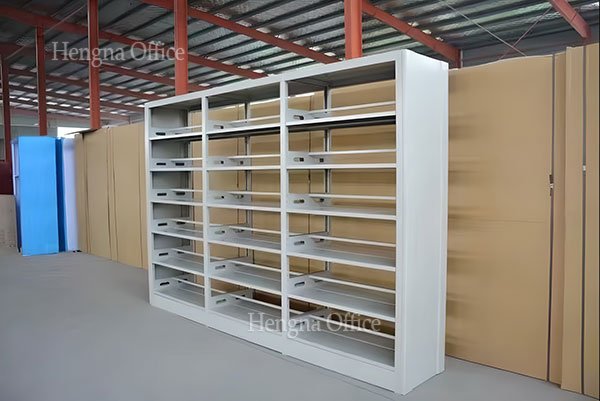
What Actually Happens When a Library Buys Cheap Shelving
We shipped a batch of double-sided steel bookshelves to a community college in south Texas two years ago. The procurement officer called us six months later — not with a complaint, but a reorder. Her words: “The first batch still looks new. That never happens with the old particleboard units.”
She had been cycling through flat-pack shelving every 18 months. Edges chipped where students put their weight against the frame. Laminate peeled at the corners. Maintenance filed a replacement ticket, the budget office approved it, and the cycle repeated. The steel units broke that cycle. Two years in, the powder coating shows no wear at contact points. The frames haven’t twisted. The shelves haven’t bowed.
That’s the difference between shelving designed for a home office and shelving engineered for 12-hour days of student traffic. This article walks through what separates the two — and what to check before you sign a PO for library shelving.
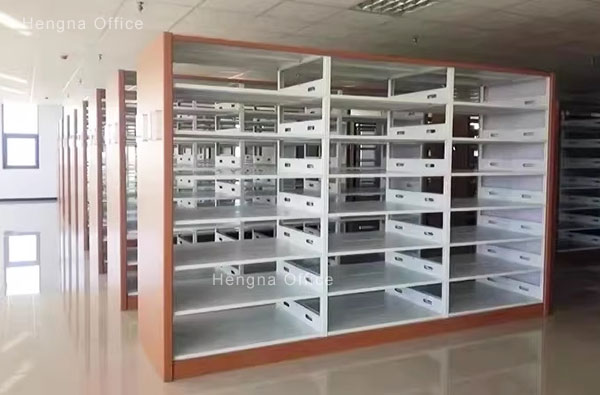
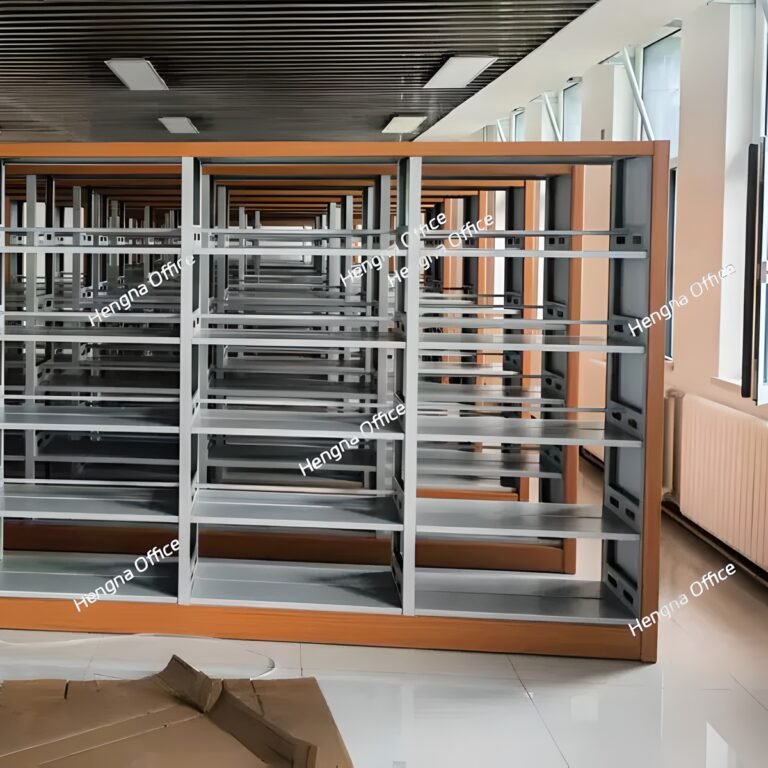
Double-Sided Steel Bookshelf-Five Tiers, Two Sides, One Frame — Why This Layout Works for Libraries
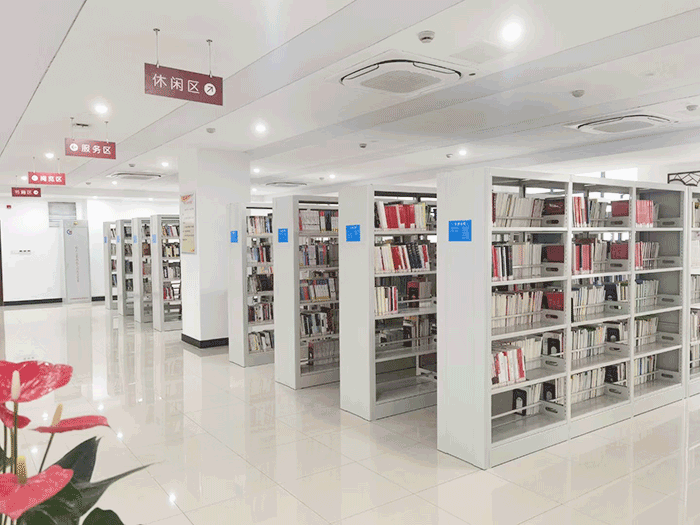
The double-sided configuration changes how people move through a space. A single-sided unit flat against a wall forces every patron into the same narrow aisle. A double-sided unit placed as a room divider creates two access lanes — patrons browse one side, staff restock the other, nobody waits.
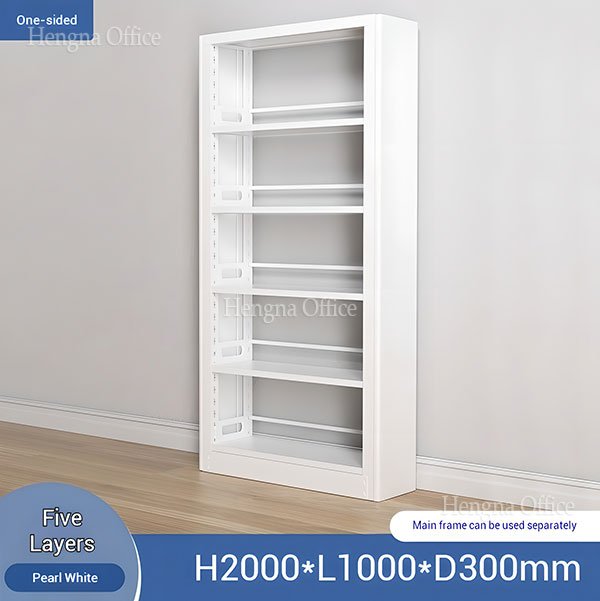
Each side holds five adjustable shelves. At 1000mm wide and 450mm deep per side, one bay stores roughly 250–300 standard hardcover books. A run of six bays — typical for a mid-sized branch library — holds 1,500 to 1,800 volumes. For a library with 40,000 books in open stacks, that’s about 25 bays total, arranged in four or five runs depending on floor layout.
The 2000mm height hits a practical sweet spot. Tall enough to squeeze five usable shelves into the frame. Short enough that the average adult can reach the top shelf without a step stool. That matters for patron satisfaction scores.
The Steel Specs That Facilities Managers Actually Ask About
Most RFPs list “heavy duty steel bookshelf.” That phrase means nothing without numbers. Here’s what a facilities director should ask:
- Shelf load rating: 80 kg per shelf, evenly distributed. That covers oversized art books, bound legal reporters, medical reference volumes, and archival boxes without sagging.
- Upright gauge: 1.2mm cold-rolled steel. This is the vertical frame that carries all the weight. At 1.0mm or thinner, uprights twist under uneven loading. At 1.2mm, they stay square. We’ve pulled units out of libraries after 15 years and the uprights measure within 1mm of factory spec.
- Shelf panel gauge: 0.8mm, with a formed lip on all four edges. The lip adds structural stiffness without adding weight — a flat sheet of 0.8mm steel bends easily, but the same sheet with a 15mm folded edge holds 80 kg.
- Powder coating: Electrostatic epoxy-polyester, cured at 200°C. This isn’t wet paint that air-dries. The powder melts and cross-links into a single polymer layer bonded to the steel. Scratch resistance is roughly 3× that of liquid paint.
- Base plates: Welded leveling feet with 40mm rubber pads, adjustable ±15mm. The rubber protects vinyl and epoxy flooring. The welded attachment means a foot won’t snap off when staff drag a fully loaded bay two meters during a rearrangement.
- Shelf adjustability: Punched vertical rails at 25mm increments. No tools required — lift the shelf, tilt, reposition. One staff member can reconfigure a bay in under two minutes.
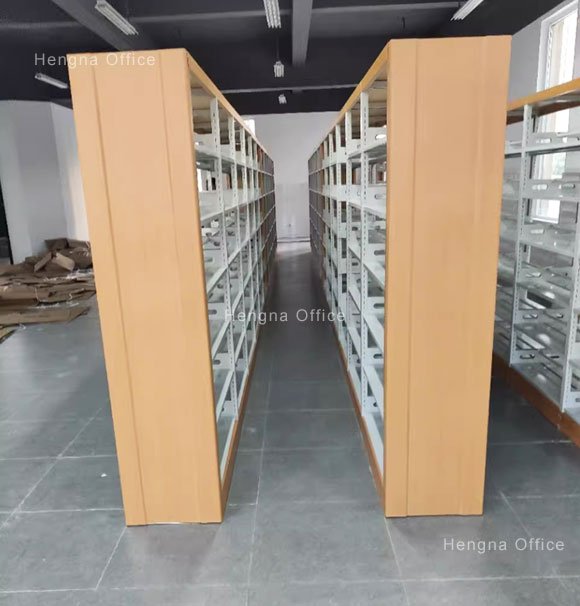
Double-Sided vs. Single-Sided: The TCO Math
A double-sided bay costs 30–40% more upfront than a single-sided unit. The payback happens in three places:
- Floor space: Two back-to-back single-sided units need about 60% more floor area than one double-sided bay, because you need access aisles on both sides and a dead zone between them. In a 200-square-meter reading room, that space difference translates to roughly 1,200 additional shelvable volumes — or 15 square meters of floor saved.
- Installation labor: One frame to unpack, assemble, level, and anchor instead of two. For a 30-bay project, roughly 4 fewer hours of install time.
- Lighting design: Fewer aisles mean fewer light fixtures. In a new build, electrical cost savings can offset 15–20% of the shelving budget.
The trade-off is flexibility. Double-sided bays weigh 200+ kg when fully loaded. They’re not something staff can casually rearrange between semesters. If your library reshuffles floor plans every 6 months, single-sided units make more sense. If the layout is stable for 3–5 years, double-sided is the better long-term buy.
Coastal and High-Humidity Libraries Need Different Coating
A library in Penang, Malaysia, ordered 40 bays from us in 2024. The building sits 300 meters from the coastline. Standard powder coating would show rust spots at weld joints within 24–36 months — we’ve seen it happen on competitor units installed in similar locations.
The fix is a zinc phosphate pre-treatment before the powder layer. The phosphate creates a crystalline layer on the steel surface that blocks moisture migration. It adds roughly 8% to unit cost and doubles salt-spray resistance in ASTM B117 testing. For any library within 5 km of saltwater, or any basement-level archive with persistent humidity above 70%, this pre-treatment is worth specifying.
Pre-Order Checklist for Library Procurement
- Get the shelf load rating in writing as a kg number, not a verbal “heavy duty”
- Request the powder coat specification sheet — curing temperature and micron thickness
- Confirm leveling feet are included in the quote, not a separate charge
- Specify welded cross-bracing between the two sides — bolted connections loosen over time
- Ask about the coating warranty specifically, separate from the structural warranty
- If coastal: require written confirmation of zinc phosphate pre-treatment
- Request the installation manual before ordering — check if it requires tools your facilities team doesn’t have
Planning a library shelving project? Send us your floor plan and collection breakdown. We’ll spec the bay count, layout, and load ratings matched to your actual books, not a generic catalog number.