Mechanical Assist Mobile File Storage — 12-Layer Archive Cabinet for Space-Limited Institutions
The Problem: Your Archive Is Full and the Building Is Heritage-Listed
A university archive in Manila hit this wall in 2025. They had 12,000 linear meters of documents packed into a basement designed for 8,000. Retrieval requests that should take 5 minutes stretched to 25. Staff were stepping over boxes to reach filing cabinets. The building was heritage-listed — zero chance of an extension.
They didn’t need more square meters. They needed more storage per square meter. The answer was mobile shelving with mechanical assist — carriages on floor rails with a geared hand-wheel drive, eliminating five out of every six fixed aisles.
Six months after installation, their linear-meter capacity in the same room went from 8,000 to just under 15,000. Retrieval time fell below 8 minutes. Staff stopped filing complaints about workspace safety. This article explains how the system works, what it costs to install, and who should — and shouldn’t — buy one.
How the Mechanical Assist Mechanism Actually Works
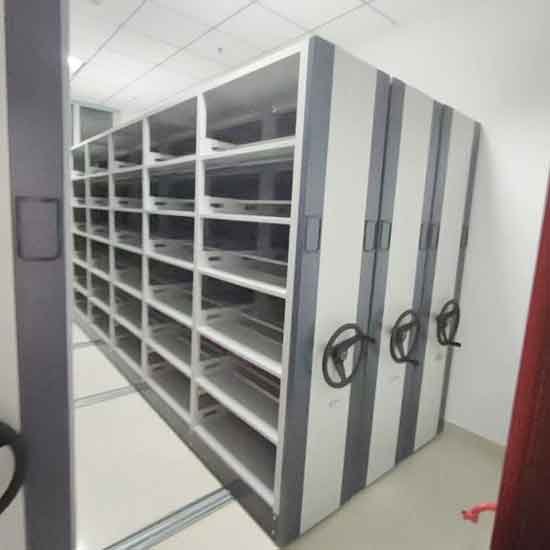
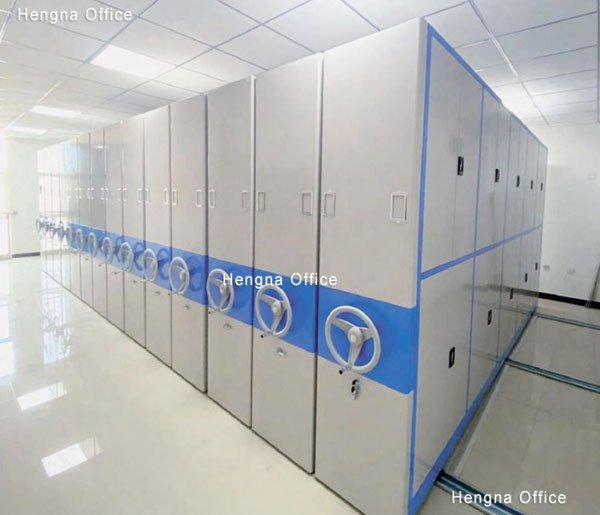
Picture a filing cabinet the size of a small car, mounted on floor rails. It weighs roughly 1,500 kg when loaded with documents. You turn a hand wheel on the end panel, and the entire thing glides sideways.
The secret is a 3:1 gear reduction box between the hand wheel and the drive chain. Three turns of the wheel equal one rotation of the drive sprocket. The effort multiplier means a 5 kg push on the wheel rim moves a 1,500 kg carriage. This isn’t hydraulic. It’s not electric. It’s gears and a chain — the same mechanical principle that moves a bicycle, scaled up.
The carriages ride on floor-mounted steel rails with sealed ball-bearing rollers. Alignment matters: rails must be within ±2mm of level across their full length. Our installation team uses a laser level and self-leveling epoxy grout under the rail bases. One day of prep, one day to mount and level, one day to assemble carriages on top.
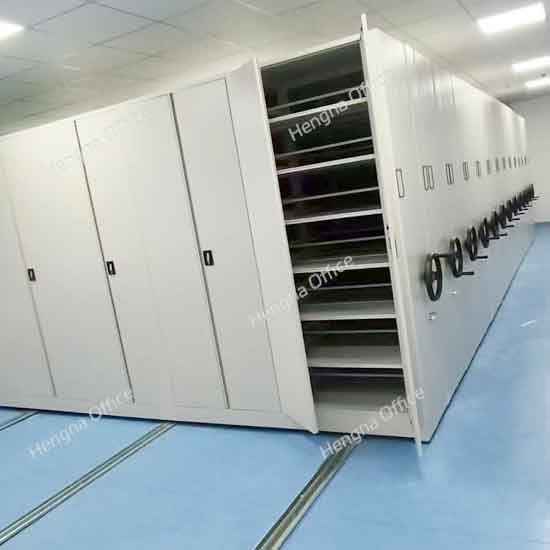
Mechanical Assist Mobile File Storage——What 12 Layers of Storage Holds
The H2400mm × W900mm × D560mm carriage packs 12 tiers into roughly 0.5 square meters of floor. Each tier spans both sides, accessed from front and back. Per-layer dimensions: 852mm wide, 341mm tall, 265mm deep.
Here is what one carriage stores:
- Standard archival boxes (400mm × 300mm × 250mm): 4 per layer, 48 per carriage
- A4 lever-arch files standing upright: roughly 16 per layer, 192 per carriage
- Bound ledgers or large-format registers (A3): lay flat on any shelf; adjustable height means you can allocate 2–3 layers for oversize items
- Mixed document types: since each shelf adjusts independently in 25mm increments, you can fit three layers of A4 files (300mm each), two layers of archival boxes (350mm), and still have room for ledger storage
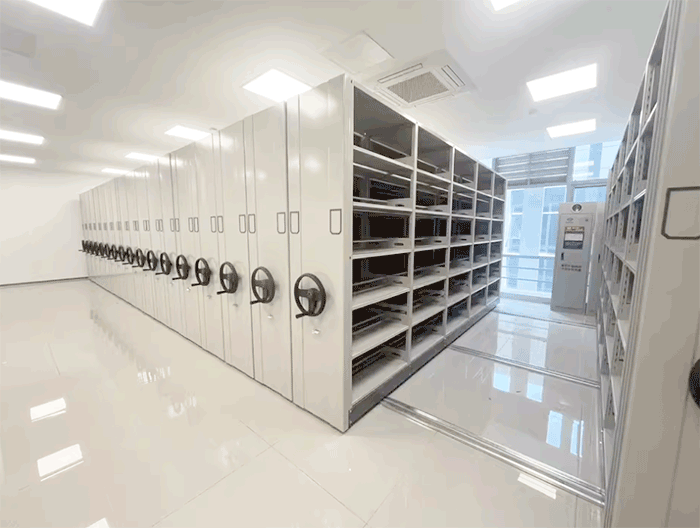
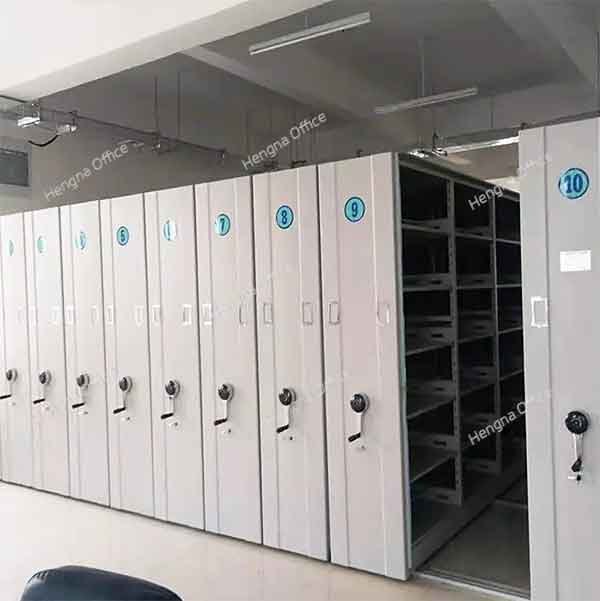
Six carriages side by side, touching when closed, with one 900mm aisle that moves to whichever carriage you need. That same room with fixed shelving would have five 900mm aisles — 4.5 meters of aisle eating 56% of your floor. Mobile cuts it to one aisle, roughly 12% of floor area.
Mechanical vs. Electric: Why Most Archives Choose Mechanical
Electric mobile shelving exists — push a button, the carriages hum apart. Convenient, until the motor burns out in year 7 and the replacement part is discontinued. Or the control board gets fried in a power surge. Or the building loses electricity and the backup generator doesn’t cover the archive room.
Mechanical assist wins on three practical fronts:
- Zero electronic failure points: A chain, a gearbox, bearings, and a hand wheel. Nothing that a facilities technician can’t service with standard tools. Annual maintenance is lubricating the chain and checking rail alignment — 30 minutes per carriage.
- No electrical infrastructure: No dedicated circuits, no conduit runs, no electrician call-out for the installation. The shelving installer handles everything.
- Lower total cost: Mechanical systems run 25–35% less than equivalent electric systems. Over a 15-year service life, you also avoid motor replacements and control system upgrades.
The trade-off is physical effort. For archives accessed 5–20 times per day, turning a hand wheel is a non-issue. For records centers with 50+ retrievals daily, the cumulative effort adds up — electric may justify the premium there. For the institutional archives that make up 80% of our orders, mechanical assist is the pragmatic middle ground between a fully manual crank and an over-engineered electric system.
Floor Requirements That Can Derail a Project
Mobile shelving concentrates weight at the rail positions. A six-carriage system fully loaded can exert 3,000 kg of point load along each rail. The floor slab must handle it.
Rules of thumb from our installation experience:
- Concrete slab: minimum 150mm thick for ground floor; 200mm for upper floors
- Floor level: within ±3mm across a 3-meter span. Older buildings often need rail shimming — adds half a day to installation, not a dealbreaker
- Floor covering: carpet must be cut back at rail positions so rails sit directly on concrete. Vinyl and epoxy flooring can stay; rails mount on top
- Tile floors: the installer should pre-drill test holes — some ceramic tiles crack under expansion bolt pressure and need a resin anchor alternative
Always have a structural engineer review the floor plan before ordering. A one-hour consultation is cheaper than cracking a slab.
Who Should Buy Mechanical Assist Mobile Shelving
These systems work best for:
- University archives and special collections: Decades of theses, administrative records, and rare materials. Space is locked; collection keeps growing.
- Hospital medical records departments: Paper records persist in large volumes where digital transition is years away. Retrieval speed matters for patient care.
- Law firm document storage: Case files with long retention periods. Mobile shelving keeps them in-house instead of paying for off-site storage.
- Government registries: Land titles, property deeds, survey maps — large-format documents needing wide, flat shelving.
They’re less suited for records centers with 50+ daily retrievals (electric may be better), or very small rooms under 20 square meters (the rails and end panels eat too much fixed space).
Need a quote? Send us your floor dimensions, document types, and volume estimates. We will return a layout drawing with carriage count, rail positions, and projected capacity increase.

![High-Density Manual Mobile Shelving for [Institutional Records Management] & Public Storage](https://getstorshelving.com/wp-content/uploads/2026/02/RER_fixed.jpg "High-Density Manual Mobile Shelving for [Institutional Records Management] & Public Storage")