Modular Steel Shelving for Warehouses — Reconfigure Layouts Without Buying New Racks

What “Modular” Actually Means on a Warehouse Spec Sheet
Every shelving supplier claims their racks are modular. Few mean the same thing. In practice, modular steel shelving means three things you can verify yourself: shelves move without tools, bays bolt together without welding, and the whole unit comes apart into standard panels that fit back together somewhere else.
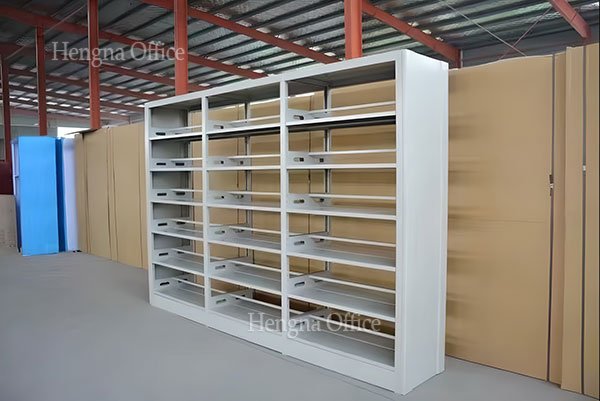
The typical system uses upright frames, horizontal beams, and shelf panels held in place by clips or punched slots. Shelf heights adjust in 25mm increments. To move a shelf, you lift it, tilt it out of the slots, and reinsert at a new height. No drill, no wrench, no second person unless the shelf is loaded.
That sounds simple. It matters more than most warehouse managers expect, because the real cost of storage is not the rack — it’s what happens when your inventory mix changes and the racks can’t keep up.
The Reconfiguration Math: When Moving Shelves Beats Buying More
Picture a spare parts warehouse that carried mostly small boxes for two years. The supplier signs a new contract for bulky filter units — 60cm tall, 40cm deep, heavy. The existing shelves are spaced at 25cm, sized for the old inventory. Now half the warehouse holds air above every box, and the new filters don’t fit anywhere.
Two options. Option one: buy 15 new racks, clear floor space, dispose of old racks, pay for installation. Option two: reconfigure the existing bays — collapse every third bay, use the freed uprights to build taller sections, set shelf spacing to 65cm in the filter zone. One crew, one weekend, zero new steel.
This is the core economics of modular shelving: you pay once for the frame, and the frame adapts as your inventory changes. A welded rack is a permanent commitment to one layout. A modular rack is a storage asset that reconfigures to whatever the business becomes.
Four Warehouse Scenarios Where Modular Shelving Pays Off
1. Seasonal inventory swings
Retail distribution warehouses see volume shift by category across the year. Holiday goods in Q4, lawn and garden in spring. With modular shelving, the layout changes twice a year — shelf heights, aisle positions, even bay counts per zone. With fixed racks, you rent overflow space every peak season instead.
2. SKU proliferation
Product lines grow. A distributor that carried 2,000 SKUs five years ago now carries 6,000. Box sizes vary wildly. Modular racks let you mix 20cm and 80cm shelf spacing in the same bay, matching the packaging reality instead of forcing everything into one grid.
3. Department reorganizations
When picking zones move or departments merge, modular bays break down and rebuild in the new layout. Staff hours matter, but so does continuity: the same steel stays in the building, just repositioned.
4. Facilities relocation
Moving warehouses is expensive. Moving modular shelving costs a fraction of replacing it. Standard bays dismantle into panels that stack flat on a pallet. At the new site, reassembly takes roughly half the time of the original installation.

What to Check Before You Buy
The word “modular” on a brochure doesn’t tell you if the system will survive five years of reconfiguration. Check these specific points:
- Upright gauge: 1.2mm cold-rolled steel minimum for warehouse duty. At 0.8mm, uprights distort during repeated reassembly — the punched slots stretch and shelves start rattling.
- Clip design: Steel butterfly clips hold better than plastic. Each shelf panel should sit on four clips minimum, rated for the panel’s full load.
- Shelf lip: A formed lip on all four edges adds stiffness. Flat panels of the same gauge flex 30-40% more under identical loads.
- Load rating per shelf: Demand the number in kg for evenly distributed load and for point loads. Warehouse boxes rarely distribute weight evenly.
- Panel dimensions: Standard widths are 900mm, 1100mm, 1500mm. If your inventory uses pallets or long items, verify the depth options before committing to a layout.
- Spare parts availability: Ask if clips, shelf panels, and uprights are sold individually. If the answer is “full bay only,” reconfiguration gets expensive fast.
Modular vs Welded: A Straight Comparison
Welded racks have one genuine advantage: they never loosen. No clips, no slots, no bolts — the geometry is fixed at the factory. If your layout will not change for 10 years, welded steel is the simpler, marginally cheaper option.
Modular racks trade that rigidity for flexibility. The trade-off is real but smaller than most buyers assume. A quality boltless system with 1.2mm uprights and steel clips holds its geometry well under normal warehouse loads. The joints are mechanical, not welded, but the engineering compensates — that’s what the 80 kg per shelf rating is built around.
Choose modular when: your inventory mix changes at least once a year, you’re in leased space, or you anticipate moving. Choose welded when: the layout is permanent, loads are extreme, or seismic bracing requirements dominate the design.

Mistakes We See in Warehouse Installations
Over three years of supplying shelving, the same five errors show up repeatedly. Avoid them and your installation will outlast the building lease.
- Overloading the top shelf: Staff put heavy boxes on the highest shelf because it’s “out of the way.” The top shelf carries the same rating as the bottom, but access is worse and falls are more damaging. Load heavy items low.
- Ignoring floor level: Modular racks tolerate uneven floors better than welded frames, but not indefinitely. Shim the feet; don’t let a rack rock on a concrete seam.
- Mixing brands: Uprights from one supplier and panels from another rarely match hole patterns. Standardization on one system pays off at reconfiguration time.
- Skipping the wall anchor: Free-standing bays under 2 meters are stable. Taller bays, especially loaded top-heavy, should anchor to the wall or floor per the manufacturer’s instructions.
- Forgetting aisle width: The reconfigurable layout is great until someone designs an aisle too narrow for pallet jacks. Plan minimum 1200mm for manual handling, wider for equipment.
Pre-Order Checklist for Warehouse Managers
- Upright gauge confirmed as 1.2mm minimum, in writing
- Shelf load ratings stated in kg, even and point loads separately
- Clip type and quantity per shelf confirmed (steel clips, 4 minimum per panel)
- Spare parts sold individually — confirm availability for clips and panels
- Floor leveling shims included or quoted separately
- Wall anchoring hardware included for tall bays
- Reconfiguration instructions provided with the delivery
- Delivery access measured: door widths, elevator sizes, corridor turns
Send us your current inventory dimensions and the changes you expect over the next two years. We will quote a modular system sized to today’s SKUs with headroom for next season’s.
Frequently Asked Questions
Can modular shelving hold the same weight as welded racks?
A quality boltless system with 1.2mm uprights and steel clips is rated for the same per-shelf loads as a welded unit — 80 kg per shelf in our specification. The joints are mechanical rather than welded, but the engineering compensates with formed lips and reinforced connection points. The real difference appears in extreme conditions: seismic zones and very heavy point loads favor welded frames. For normal warehouse use, modular and welded racks are equivalent in practical capacity.
How long does it take to reconfigure a bay?
A two-person crew reconfigures a standard bay — moving shelf heights, adding or removing a tier — in 20 to 30 minutes without tools. A full-warehouse layout change with 50 bays takes a weekend. The math matters because the alternative is buying new racks and waiting weeks for delivery. Reconfiguration time is the hidden cost saving of modular systems.
Do boltless shelves loosen over time?
With the right clip design, no. Steel butterfly clips engage the punched slots under load — the heavier the load, the tighter the connection. Loose shelves happen on systems using plastic clips or thin uprights that let the slots stretch. Specifying 1.2mm uprights and steel clips eliminates the problem in practice.
Can modular racks be used for pallet loads?
Not in the standard configuration. Shelf panels rated for 80 kg per shelf are designed for carton and small-box storage, not pallets. Pallet loads need heavier beam-based racking with a different frame geometry. If your mix includes both pallets and cartons, plan two zones with different systems.