Mobile Shelving for Small Offices — 5 Ways to Recover Floor Space in Tight Workplaces

The Small Office Storage Squeeze
Small offices hit the storage wall differently than big ones. A large company has options — a records center, a basement floor, a warehouse wing. A 20-person firm with a 12-square-meter storage room has one option: make the room hold more, or start throwing things away.
Most small offices choose a mix: cram more boxes in, stack higher, and quietly lose track of what’s where. The retrieval time creeps up, then the frustration, then someone rents a storage unit — and the records are now 20 minutes away instead of 20 seconds.
Mobile shelving changes this without a building project. The same shelving, mounted on carriages and rails, typically doubles the storage density of the room it sits in. Here are five ways that plays out in a small office, with the numbers that matter.
1. Turn Aisles Into Storage
A 3-meter-wide storage room with static shelving on both walls needs a central aisle of roughly 900mm to access either side. That aisle runs the full length of the room and does nothing but let people walk. In a 4-meter-long room, that’s 3.6 square meters — nearly a third of the floor — dedicated to walking.
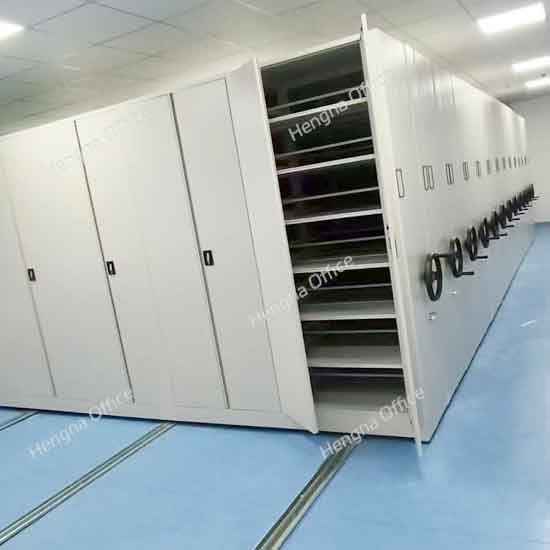
Mount one side on rails and the aisle disappears. The mobile carriage slides toward the fixed shelving when not in use, and the single access point moves to wherever you’re working. The room doesn’t get bigger; the usable storage gets roughly twice as dense.

2. Stack Vertically With a Safe Reach
Small rooms tempt people to stack to the ceiling. The problem: anything above 2000mm becomes a ladder job, and ladder jobs in a storage room are how small offices get their insurance claims.
A mobile carriage at 2000-2400mm tall puts the top shelf at a height where a small step stool works safely. Because the carriage brings the shelf to the aisle instead of the person climbing to the shelf, even the top tiers stay practical for everyday retrieval. You gain a tier or two per column compared to “safe reach” static shelving.
3. Consolidate Dispersed Storage
Small offices store records everywhere: a shelf in the IT closet, two cabinets by the reception desk, boxes under the accounting workstations. Every location is a separate inventory, and items get “lost” because nobody remembers which spot holds them.
One mobile carriage system concentrates all of it in one room. The density gain isn’t just physical — it’s organizational. One room, one inventory, one retrieval process. Offices that consolidate this way typically find they were storing the same files in three places.
4. Free Prime Office Space
The most expensive square meters in any office are the ones by windows and near the entrance. Records storage in prime space is the most expensive way to store paper.
Moving records into a compact mobile system in a utility room frees the prime space for people, meeting tables, or revenue-generating desks. For a small office paying rent on every square meter, this is often the real payoff — not the storage gain, but the recovery of high-value floor.
5. Grow Without Moving
The quiet killer of small offices is the forced move. Records accumulate, the office outgrows itself, and the lease renewal comes with a relocation that costs weeks of disruption and thousands in moving expenses.
Mobile shelving buys years. Doubling the storage density of existing rooms often delays a move by 3-5 years — enough time to grow headcount, sign a better lease, or both. For a small business, that’s the difference between growing on your own terms and growing under a deadline.
Room Size Reality Check
Mobile shelving works down to about 8-10 square meters of room, but the gain shrinks with the room. Below that, the rail hardware and end panels eat too much of the space. The sweet spot for small offices: rooms of 12-30 square meters, where the density gain is real and the rail cost is amortized over a meaningful amount of shelving.
Also measure the door. Carriages assemble inside the room, but the rails arrive in 3-meter lengths. If the storage room door is under 800mm wide and the corridor has tight turns, plan for rail delivery before installation — it’s a logistics note, not a blocker.
Manual vs Mechanical Assist for Small Offices
Most small-office installations use manual drive — a direct hand wheel on the carriage end. Carriages in a small room rarely exceed 800 kg loaded, and manual drive handles that with 5-7 kg of hand force. It’s the lowest-cost option and needs almost no maintenance.
Choose mechanical assist (geared hand wheel) if your carriages exceed 900 kg loaded — common when storing heavy binders or boxes — or if the retrieval frequency is high enough that every bit of effort counts. The gearbox adds roughly 25-30% to the carriage cost and pays for itself in daily comfort.
Safety in a Small Room
Small rooms concentrate more bodies and boxes in less space, so safety details matter more:
- Aisle lock required: when the aisle is open, adjacent carriages stay locked until someone releases the mechanism
- Floor sweep sensors on every carriage face — a dropped box or a foot stops the carriage
- End stops with rubber bumpers on both rail ends
- Clear marking of the aisle position when carriages move
- Fire extinguisher access: keep at least one static aisle position that never closes
These aren’t optional extras. They’re the baseline for moving a 700 kg carriage in a room where someone could be between the rows.
Is Mobile Shelving Right for Your Small Office?
Run this quick filter: your storage room is 12 sqm or larger, records are accessed a few times a day at most, the floor is concrete or on a structural slab, and you’re out of space. If three of four are true, mobile shelving is worth a quote.
If retrieval is constant, the room is tiny, or the floor can’t take the weight, keep static shelving and look at off-site storage instead. Send us your room dimensions and storage mix — we’ll tell you honestly which way the math goes.
Frequently Asked Questions
Can mobile shelving fit through standard office doors?
The carriages assemble inside the room — only the rails arrive as long pieces. Standard rails come in 3-meter lengths, which pass through 800mm doors with room to spare. If the storage room is in a basement with narrow stairs, plan rail delivery before installation.
What is the minimum room size for mobile shelving?
Around 8-10 square meters is the practical floor. Below that, the rail hardware and end panels consume too much of the space and the density gain disappears. Rooms of 12-30 square meters are the sweet spot for small-office installations.
Are manual drive systems hard to operate?
No. A manual hand wheel on an 800 kg loaded carriage needs 5-7 kg of hand force — comparable to turning a stiff doorknob. If the carriage exceeds 900 kg loaded, step up to mechanical assist with a geared wheel, which cuts the effort to roughly a third.
Can I add carriages later as storage needs grow?
Yes, if the rails are laid with spare length. Order rails sized for the maximum future carriage count and install extra anchor points now. Adding a carriage later is a two-day job instead of a full reinstallation.