
Prevent Library Shelving Tip-Overs — 5 Safety Rules Every Facility Manager Should Enforce
I remember the day a library near us had a shelving unit tip. It wasn’t in an earthquake and nobody was hurt, which is exactly why it stuck with me — it happened in ordinary conditions, on a level floor, during a normal afternoon. The unit had been loaded unevenly for months, the top shelf heavy and the bottom nearly empty, and it wasn’t anchored. One person pulled a book from the top row and the whole thing came down. The takeaway wasn’t bad luck. It was five rules that were never enforced.
This guide is for facility managers, librarians, and anyone responsible for shelving in a space where people walk. It covers the five safety rules that prevent shelving tip-overs, why each one matters, and how to enforce them so they actually stick. If you manage a library, an archive, a school, or a storeroom, read this before someone learns the hard way.
Why shelving tips over
Before the rules, the physics. A tall shelving unit tips when the force pulling at the top overcomes the weight holding the base down. That happens three ways: too much weight high up, too little weight low down, and no anchoring to resist the pull. A shelf that’s top-heavy, bottom-empty, and loose is a tipping shelf waiting to happen.
The fix isn’t mysterious. Keep the weight low, spread it evenly, and anchor the unit. Every rule below is a way of doing one of those three things. Enforce all three and tip-overs become close to impossible in normal conditions.
Rule 1: Anchor tall shelving to the wall
The single most effective rule is anchoring. Any shelving unit taller than about head height should be secured to the wall with brackets or straps designed for the job. An anchored shelf can still be pulled, but the bracket takes the force instead of the unit tipping.
This is non-negotiable in public and children’s areas. A bracket costs a few dollars and takes minutes to install, but it turns a potential accident into a non-event. If your shelving has no anchor points, add them before anyone loads a single book.
Rule 2: Keep heavy books on the lower shelves
The height of the weight matters more than the total weight. Put the heaviest items — reference sets, bound volumes, heavy equipment — on the bottom one or two shelves. Keep the top shelf light. A unit with its mass low is far harder to tip than one with the same total weight stacked high.
In a library, that means shelving the heavy folios and reference works where they belong, not jammed on the top row because it’s convenient. Make it a loading habit, not a one-time fix, and check it whenever a shelf gets rearranged.
Rule 3: Spread the load evenly, across the width
An evenly loaded shelf resists tipping; a shelf loaded on one side wants to lean. Spread books and boxes across the full width and depth of each shelf, and don’t let heavy items pile up in one corner. A leaning, one-sided load makes even a well-built shelf unstable.
This rule also protects the shelf itself. Even loading prevents the shelf plate from bowing under a concentrated weight, which keeps the unit square and stable over years of use. Evenly loaded shelves are both safer and longer-lived.
Rule 4: Never over-fill the top of a tall unit
The most common tip-over scenario is a tall unit that’s packed to the top and empty at the bottom. The top gets filled because it’s the last space left, and the bottom gets ignored because it’s awkward. That’s the exact pattern that makes a unit tip.
Enforce a simple rule: the top shelf of a tall unit stays light, and the bottom stays loaded enough to anchor the weight down. If you must store tall or heavy items, keep them low. A unit that’s heavy at the bottom and light at the top is stable; reverse that and you’re asking for trouble.
Rule 5: Inspect regularly, and check for signs of lean
Tip-overs rarely happen suddenly. They build up over months — a unit slowly leaning, a shelf plate bowing, a bracket loosening. The fifth rule is to catch that before it becomes a problem. Walk the shelving regularly and look for three things: a unit that’s no longer level, a gap between the unit and the wall where an anchor used to be, and shelf plates that sag under load.
Make it part of a routine. A monthly walk-through that checks leveling, anchoring, and load balance catches most problems before they matter. Log what you check, and fix anything that’s off the day you find it.
How to enforce the rules so they stick
Rules only work if people follow them. Three habits make these stick. First, make loading a trained task: whoever fills shelves learns heavy-low, light-top, even-spread. Second, put the anchor check into your routine maintenance, not just initial setup. Third, catch and fix early — the moment a unit leans or a bracket loosens, it gets addressed, not postponed. Rules enforced this way become routine, not exceptions.
Posting the five rules near the shelving area also helps. A short sign — “heavy books low, top light, even load, anchored, check monthly” — reminds staff and keeps the standards visible. It’s cheap, and it turns a policy into a habit.

FAQ
Is anchoring really necessary for short shelving?
Short, low units are stable on their own, but any tall unit (roughly head height or above) should be anchored. In children’s or public areas, anchor generously.
How often should I check my shelving?
At least monthly. Look for leaning, loose anchors, and sagging shelf plates, and fix anything off the day you find it.
Does the type of shelving matter for tip risk?
Yes. A unit with a low center of gravity and a wide base is inherently more stable. Height, base width, and how it’s loaded all affect tip risk.
Can I stop anchoring if my shelving is heavy-duty?
No. Heavy-duty steel is strong, but it still tips if it’s top-heavy, bottom-empty, and unanchored. Anchoring protects regardless of build.
What’s the cheapest safety upgrade?
Anchor straps or brackets on all tall units, plus a monthly check. It’s a few dollars per unit and minutes per month for real prevention.
Why buy from us
We supply steel library shelving and storage racks direct from partner production lines, and we build stability into the design — low centers of gravity, wide bases, and anchor points on taller units. If you’re outfitting a library, an archive, or a facility and want shelving that’s built to stay put, we’ll help you spec the right units for your space and your traffic.
Tell us your room and how much you need to store, and we’ll recommend shelving that’s stable by design — then hand you the safety rules to keep it that way.
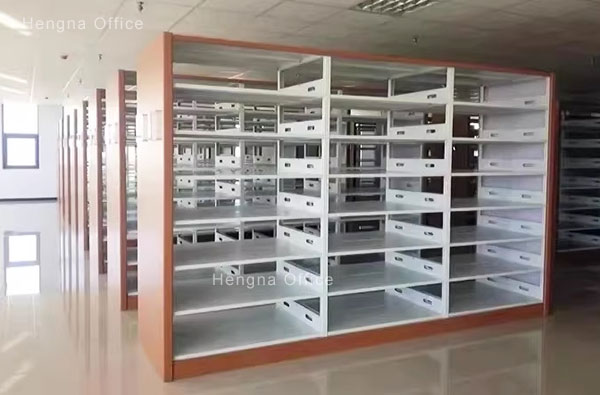
I remember the day a library near us had a shelving unit tip. It wasn’t in an earthquake and nobody was hurt, which is exactly why it stuck with me — it happened in ordinary conditions, on a level floor, during a normal afternoon. The unit had been loaded unevenly for months, the top shelf heavy and the bottom nearly empty, and it wasn’t anchored. One person pulled a book from the top row and the whole thing came down. The takeaway wasn’t bad luck. It was five rules that were never enforced.
This guide is for facility managers, librarians, and anyone responsible for shelving in a space where people walk. It covers the five safety rules that prevent shelving tip-overs, why each one matters, and how to enforce them so they actually stick. If you manage a library, an archive, a school, or a storeroom, read this before someone learns the hard way.
Related Reading
- Library Storage Steel Bookshelf Anti-Tipping Safety 79″ H — five tier shelving
- V-Shaped Library Book Cart with Locking Casters — heavy-duty load ratings
- How to Buy Steel Library Shelving from China in 2026 — heavy-duty load ratings
Browsing by need rather than by model? Start from library shelving.


2 Comments