
Warehouse Storage Rack Buying Checklist — 12 Points on Load, Coating & Assembly Before You Order
I watched a small business owner order warehouse shelving on price alone, and it cost him a year of headaches. The racks were cheap, the load ratings were vague, and within months one shelf plate was visibly bowing under a stack of heavy boxes. He’d saved a little on the invoice and lost far more on time, floor space, and a near-miss when a loaded shelf sagged during a lift. The mistake wasn’t choosing steel. It was ordering before he had a checklist.
This guide is that checklist. It covers the twelve points to check on load, coating, and assembly before you order warehouse storage racks — the ones that separate a rack that lasts a decade from one that wobbles within a year. If you’re outfitting a warehouse, a store room, or a workshop, work through these before you sign an order.
Load: the numbers that actually matter
Load ratings are where cheap racks hide their weakness. A real spec gives you load per shelf for an evenly distributed load on a level floor, properly assembled. Vague “heavy duty” with no number is a red flag. Before you compare prices, pin down three load figures: load per shelf, load per bay, and the maximum weight per upright column.
- Load per shelf — how much an individual shelf holds, evenly distributed.
- Load per bay — the total across all shelves of one bay.
- Load per column — the weight the upright can carry, which sets the bay limit.
Ask for all three in writing. A rack that claims a big per-shelf figure but a low per-column figure can’t actually hold what its shelves promise, and that mismatch is how racks fail unexpectedly.
Load, continued: read the fine print
Two details change how the load rating works. First, it assumes an evenly distributed load — stack boxes evenly across the shelf, not all in one corner. Second, it assumes a level floor. On a sloped warehouse floor, the real safe load drops. Ask whether the quoted figure already accounts for your floor condition, and load conservatively if your floor isn’t perfectly level.
Also check dynamic vs. static load. Static load is what the rack holds sitting still; dynamic load includes the extra force of moving, lifting, or palletizing on it. If you’re using a forklift or pallet jack, make sure the rack is rated for the dynamic loads you’ll actually put on it.
Coating: what protects the steel
Steel racks live in warehouses where moisture, dust, and occasional scrapes are unavoidable. The coating is what keeps the steel from rusting and flaking. Most good racks are powder-coated — a baked-on finish that resists scratches, chips, and rust far better than ordinary paint. Ask two questions: what coating, and how thick?
A proper powder coat holds up to the daily bumps of carts, pallets, and dropped boxes. A thin or painted finish flakes sooner, and once it flakes, the steel underneath starts to rust. If you’re storing in a damp or coastal area, coating quality matters even more. Don’t skip this question — it’s the difference between a rack that looks new for a decade and one that’s rusty in two years.
Assembly: flat-pack and how it goes together
How your rack assembles affects both cost and setup effort. Flat-pack racks ship knocked down — columns, beams, shelves, and clips flat in boxes — and assemble on site with basic hand tools and no welding. That cuts freight cost a lot, because you’re not paying to ship air. On arrival, most flat-pack racks go together in minutes.
Ask how the beams connect to the columns. A good rack uses a clip or butterfly-hole design that locks the beam into the upright without welding or screws. That’s faster to assemble, easier to reconfigure, and just as strong when properly fitted. Confirm the hardware is complete and that assembly needs no special tools.
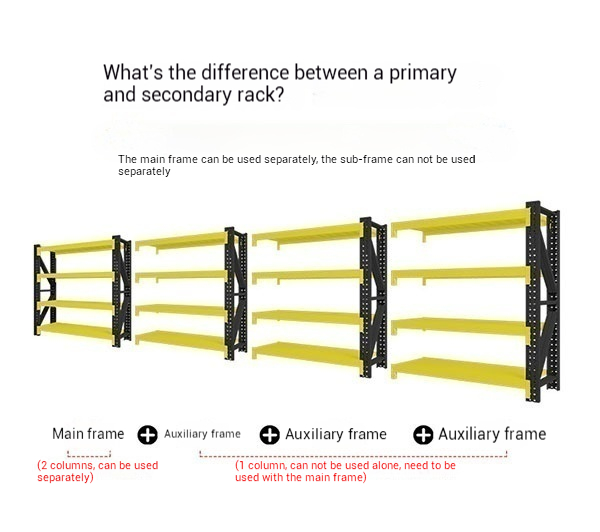
One structural point buyers miss is the difference between a main frame and an auxiliary frame. A main frame has two columns and can stand alone. An auxiliary frame has one column and must be joined to a main frame to work. When you order a run of racks, count how many main frames you need at the ends — they’re the ones that give the run its support. Under-ordering main frames is a common mistake that leaves racks leaning.
The 12-point checklist, top to bottom
- Load per shelf — a real number, evenly distributed, on level floor.
- Load per bay — total capacity across all shelves of one bay.
- Load per column — the upright’s weight limit, which sets the bay cap.
- Dynamic vs. static load — rated for forklift and pallet-jack use if you need it.
- Coating type — powder-coated or painted? Which one?
- Coating thickness — thick enough to resist flaking and rust.
- Steel gauge — column and beam thickness that won’t flex.
- Beam-to-column connection — clips or butterfly holes, no welding or screws.
- Adjustable levels — can shelves move to different heights?
- Flat-pack vs. assembled — flat-pack ships cheaper and assembles on site.
- Floor requirements — level floor, and any shimming needed.
- Warranty and support — what’s covered if a batch arrives defective.
Walk a supplier through these twelve and you’ll separate a real production source from one quoting generic specs. A good supplier answers every line; the rest stall or deflect.
Common mistakes buyers make
The mistakes I see repeat are worth naming. Choosing price over spec and ending up with thin steel that sags. Ordering without a load audit, then discovering the rack can’t hold your heaviest items. Ignoring coating and finding rust within two years. Not confirming the beam connection, then wrestling with racks that wobble. And skipping the floor check, so a “level” rack leans on a sloped floor.
None are hard to avoid. Confirm specs in writing, work the checklist, and load conservatively until you’ve seen the rack perform. Do that and your racks will hold what you need for years.
FAQ
What’s the most important spec on a storage rack?
The load per shelf, bay, and column — all three. A rack can’t hold more than its weakest number, so check them together.
Is powder coating worth paying for?
Usually yes. It resists scratches, chips, and rust better than paint, which matters in a warehouse where racks get bumped daily.
Do I need a forklift-rated rack?
Only if you use a forklift or pallet jack on the rack. If you do, confirm the rack is rated for the dynamic load, not just static.
Can I assemble a flat-pack rack myself?
Yes. Most flat-pack racks assemble with basic hand tools and no welding, using clips or butterfly-hole connections.
How much floor prep do storage racks need?
Level, sound floor. If your floor isn’t level, shim the feet and load more conservatively.
Why buy from us
We supply warehouse storage racks direct from partner production lines, and we build them with real load ratings, proper powder coating, and clip-together assembly. That means we can answer every point on the checklist above with actual specs, not generic claims. If you’re outfitting a warehouse or a store room, we’ll help you size the rack to your load — and tell you what it will really hold.
Tell us what you’re storing and how heavy it is, and we’ll quote a rack built around your numbers.
I watched a small business owner order warehouse shelving on price alone, and it cost him a year of headaches. The racks were cheap, the load ratings were vague, and within months one shelf plate was visibly bowing under a stack of heavy boxes. He’d saved a little on the invoice and lost far more on time, floor space, and a near-miss when a loaded shelf sagged during a lift. The mistake wasn’t choosing steel. It was ordering before he had a checklist.
This guide is that checklist. It covers the twelve points to check on load, coating, and assembly before you order warehouse storage racks — the ones that separate a rack that lasts a decade from one that wobbles within a year. If you’re outfitting a warehouse, a store room, or a workshop, work through these before you sign an order.
Related Reading
- Modular Steel Shelving for Warehouses
- 4 Tier Steel Storage Rack 200kg Per Shelf
- Boltless Steel Storage Racks — kd flat-pack assembly
Browsing by need rather than by model? Start from heavy-duty load ratings or warehouse and industrial storage.



4 Comments