
Electric vs Manual Mobile Shelving — Which Compact System Doubles Your Archive Space for Less?
Last month I walked through a law firm’s records room with the office manager. She had 4,000 box files spread across twenty fixed shelving bays, and she was running out of floor space. Her question was the one I hear everywhere: “If I put it all on mobile shelving, do I really double my storage? And do I need the electric version?” She’d been quoted two prices that looked like different products entirely.
This guide answers both questions directly. You’ll learn how much space mobile shelving actually saves, when to buy electric, when manual makes more sense, and what the cost difference really buys you. If you’re deciding between electric and manual mobile shelving for an archive, a library, or a records room, read this before you sign a quote.
How mobile shelving doubles your archive space
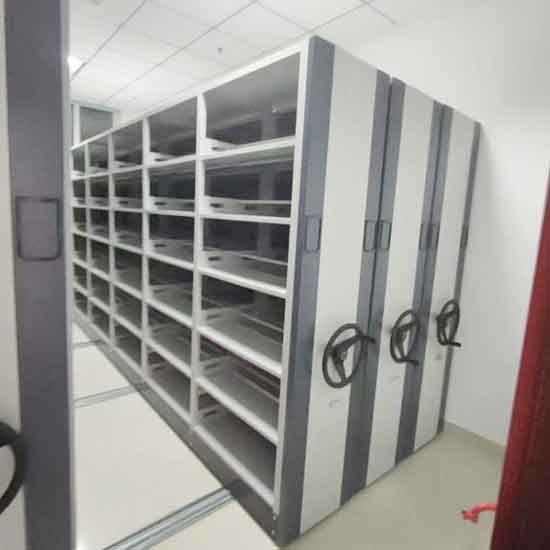
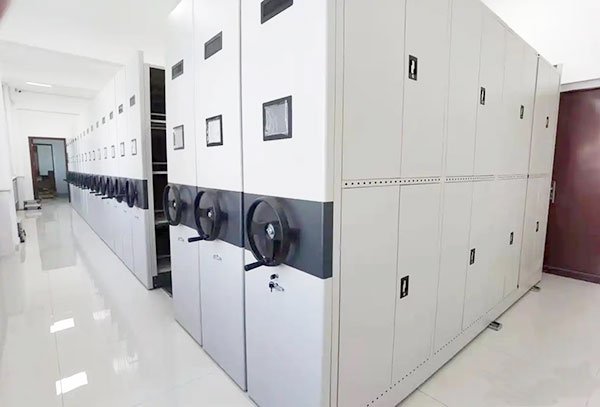
Mobile shelving (also called compact shelving or intensive shelving) works by mounting shelving bays on rails and leaving only one moving aisle instead of a fixed aisle in front of every bay. Move one row, open one aisle, walk to the file you need. Fixed shelving gives every bay a permanent aisle; mobile shelving shares one aisle across the whole run.
The math is simple. A fixed bay needs roughly 1 metre of aisle in front of it. A mobile system stores the same number of bays in roughly a third of that footprint. That’s where the “double your space” claim comes from: a room that fits one set of fixed shelves can fit about twice as many bay-equivalents on rails. In a records room, that usually means the difference between renting off-site storage and keeping everything in-house.
Electric vs. manual: what actually differs
Both systems share the same core: bays on rails, a moving aisle, safety locks. The difference is how the rows move.
| Factor | Manual mobile shelving | Electric mobile shelving |
|---|---|---|
| How it moves | Hand crank or push mechanism | Motorized, push-button or touchscreen |
| Upfront cost | Lower | Higher (motors + electronics) |
| Operation effort | Physical effort to open an aisle | Effortless, one touch |
| Best for | Light use, few users, tight budget | Heavy daily access, multiple users |
| Reliability | Fewer parts to fail | More parts; needs maintenance |
| Heavy loads | Harder to move full rows | Moves heavy loads easily |
My short answer: manual wins for small archives with light, occasional use and a limited budget. Electric wins when staff access records all day, when the rows are heavily loaded, or when you have more than one person opening aisles at once. Everything else is comfort.
Manual mobile shelving: when it’s the right buy
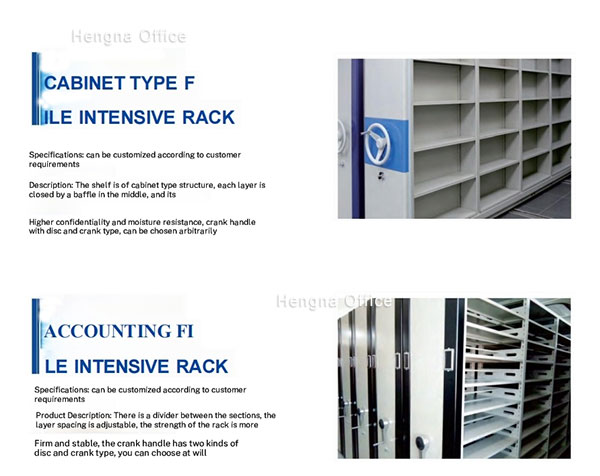
Manual systems suit records rooms and libraries that don’t need an aisle opened every few minutes. A hand crank turns the drive chain and moves the bay along the rail. For a light load, one person can open an aisle in a few turns of the handle.
Three things make manual a strong choice. First, the price is noticeably lower — you skip motors, control panels, and wiring. Second, there’s less to go wrong: no electronic parts to fail, no power outage to lock you out. Third, for a small run of bays with light loads, the physical effort is genuinely small. If your archive gets maybe twenty access requests a day, manual is usually enough.
The catch is heavy loads. A fully loaded manual row takes real effort to move, and repeated cranking across a day is tiring. If your bays hold dense records or heavy equipment and staff open them constantly, manual becomes a workout nobody wants.
Electric mobile shelving: when it pays for itself
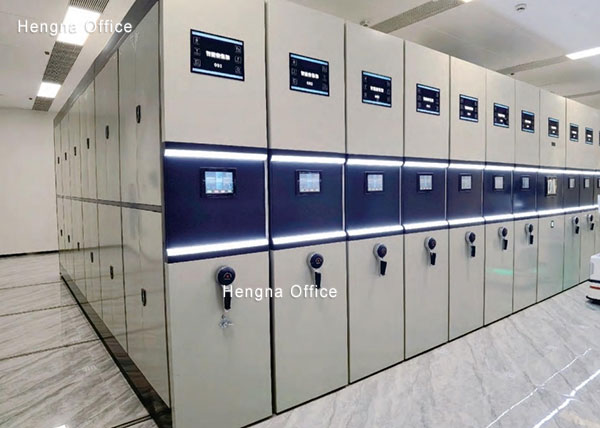
Electric systems replace the crank with a motor drive, usually controlled by a button, a keypad, or a touchscreen on each bay. Touch a button and the row glides open. That single convenience is why busy archives choose it.
Electric makes sense in four situations: frequent access, heavy loads a person can’t move comfortably, multiple users working the archive at once, and large systems where central safety locks and anti-collision buffers protect people and records.
How much does each really cost?
Exact numbers depend on your footprint, load rating, and finish, so treat these as ranges against your quotes. Manual is typically the lower entry point — you’re paying for steel, rails, and a drive mechanism, but not motors and electronics. Electric adds the drive motors, control system, wiring, and safety electronics, a premium usually worth it only where daily access justifies it.
The cheaper invoice isn’t always the cheaper system. Manual saves upfront but costs staff time every day; electric costs more but removes that daily labor. For a small team, manual wins on total cost. For a large, active archive, electric’s labor savings usually tip the total in its favor.
Safety in both systems
Whatever you choose, safety gear is non-negotiable. A good mobile shelving run has a central lock that secures the whole system, safety interlocks that stop a row closing if something is in the aisle, and anti-collision buffers that cushion the bays as they meet. These protect people from being trapped and your records from being crushed.
On electric systems, insist on sensors that halt movement the moment the aisle is occupied. On manual systems, make sure the locks engage firmly so a row can’t roll on its own. Both types need level, properly prepared floor tracks — a sloped or badly laid rail is a problem no motor or crank can fix.
What to ask a supplier before you buy
- Load rating per bay — get a real number, and check it holds your heaviest loaded shelf.
- Space actually saved — ask how many fixed bays your room fits today vs. on rails, in metres, not percentages.
- Drive type and effort — for manual, how many turns to open a loaded aisle; for electric, what the motor moves comfortably.
- Safety features included — central lock, interlocks, and buffers should be in the base price, not upsells.
- Floor track requirements — buried or surface track, leveling, and load on the subfloor.
- Maintenance and spares — who services it, and how fast parts arrive if a motor or chain fails.
- Warranty and assembly — what’s covered, and who installs the track and bays.
FAQ
Does mobile shelving really double my archive space?
In most rooms, yes, or close to it. Replacing fixed aisles with one shared moving aisle fits roughly twice the shelving in the same footprint.
Is manual mobile shelving hard to operate?
For light loads and occasional use, no — a few turns of the crank open an aisle. It gets tiring only with heavy loads and constant access, which is when electric earns its keep.
Is electric mobile shelving worth the extra cost?
For a busy archive with daily access, usually yes — the labor saved pays for the premium. For light use, manual is the better value.
Can I add electric to a manual system later?
Sometimes, but it’s rarely cost-effective. Choose the drive type before the track is laid.
How much floor preparation do I need?
Mobile shelving needs level rails on a sound floor. Discuss buried vs. surface track and subfloor load with the supplier before ordering.
Why buy from us
We supply both manual and electric mobile shelving systems direct from partner production lines. That means we control the steel, rails, drive components, and safety locks end to end — and it means flat-pack pricing that works for law firms, libraries, schools, and records warehouses alike. Tell us your room dimensions and how often staff access the records, and we’ll tell you whether manual or electric fits — and what each one really costs to run.
Last month I walked through a law firm’s records room with the office manager. She had 4,000 box files spread across twenty fixed shelving bays, and she was running out of floor space. Her question was the one I hear everywhere: “If I put it all on mobile shelving, do I really double my storage? And do I need the electric version?” She’d been quoted two prices that looked like different products entirely.
This guide answers both questions directly. You’ll learn how much space mobile shelving actually saves, when to buy electric, when manual makes more sense, and what the cost difference really buys you. If you’re deciding between electric and manual mobile shelving for an archive, a library, or a records room, read this before you sign a quote.
Related Reading
- Double Your Archive Space
- High Density Mobile Shelving Systems
- Manual Mobile Shelving for Document Centres and Repositories
Browsing by need rather than by model? Start from archive and record storage or manual vs electric drives.

2 Comments